
A mid-sized San Jose company notices unexplained payments in its records, but the entries alone don’t show what happened. That uncertainty can make business decisions harder, especially when it’s time to choose someone to examine the numbers. Forensic accounting services San Jose businesses consider can help investigate specific financial questions and explain what the records show. The work is most useful when the question, available records, and agreed scope fit together.
If you’re unsure what a forensic accountant examines or what to bring to a first conversation, you’re not alone. A suitable provider should be able to discuss your concern in plain language and clarify what the work may cover, what information is needed, and how findings will be communicated.
This guide explains the kinds of questions a forensic accountant may help examine, how to compare providers by experience, scope, communication, and impartiality, and what to prepare before an initial discussion. It can also help you frame your San Jose business’s needs so you can assess whether a proposed approach fits the matter at hand.
Key Takeaways
- Unexplained transactions or gaps in financial records can be reasons to seek a focused review, but they aren’t proof of wrongdoing.
- Forensic accounting services San Jose businesses consider should be scoped around a clear question, relevant records, and the findings the organization needs.
- Compare providers by their relevant experience, proposed scope, deliverables, communication approach, and fee transparency.
- Before an introductory conversation, note the concern, key dates, involved entities, available records, and decisions the work should inform.
- SD Mayer lists forensic accounting and accounting litigation support among its offerings. Confirm the proposed scope and deliverables for your specific needs.
When San Jose businesses should consider forensic accounting services
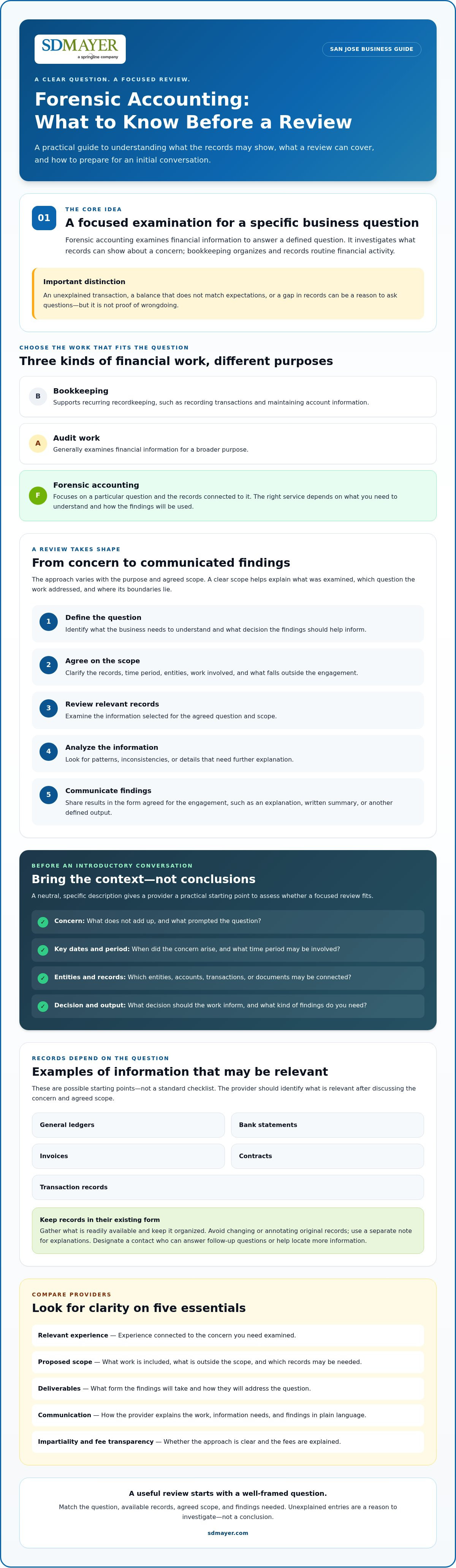
Forensic accounting is the focused examination of financial information to answer a specific business question. Put simply: Forensic accounting investigates what records can show about a defined concern; bookkeeping organizes and records routine financial activity. For a mid-sized company, the aim is to bring clarity to a decision, not to presume misconduct. The Forensic accounting overview offers additional background on the practice.
Business situations that may call for a closer financial review
A closer look may be useful when account balances don’t match expectations, a transaction is disputed, or key records appear to be missing. These are reasons to ask questions, not proof that anyone acted improperly. A focused concern helps guide the review. For example, a business might need to understand why a balance changed, how a payment was recorded, or what information is available for a particular period.
Before seeking forensic accounting services San Jose businesses can benefit from describing the issue in neutral, specific terms. Note what prompted the concern, which accounts or transactions may be involved, and what decision the findings should support. This gives a provider a practical starting point to assess whether a targeted financial review fits and discuss which records may be relevant.
Forensic accounting, auditing, and bookkeeping: what is different?
Bookkeeping supports recurring financial recordkeeping, such as recording transactions and maintaining account information. Audit work generally examines financial information for a broader purpose. Forensic accounting instead focuses on a particular question and the records connected to it. The right service depends on what you need to understand, how the findings will be used, and what output you’re requesting.
For example, a company seeking help with ongoing reporting may need a different service from one trying to understand a disputed transaction. For related context on reporting needs, see financial reporting compliance services in the Bay Area.
To decide whether specialist support may be appropriate, write down the business question and consider:
- What doesn’t add up, and when did the concern arise?
- Which entities, accounts, transactions, or records may be involved?
- What decision should the work help inform?
- Do you need an explanation of records, a written summary, or another defined output?
Clear answers give an initial conversation a practical starting point. They also help distinguish a targeted investigation from routine bookkeeping or broader reporting work, without treating an unexplained entry as a conclusion.
How a San Jose forensic accounting engagement examines records
A financial review is easier to follow when everyone understands what it is meant to answer. Forensic accounting services San Jose businesses consider should start with a clear business question, then establish what work and records are relevant. The process varies with the purpose of the engagement and its agreed scope, so don’t assume every review follows the same steps or timeline.
From the initial question to an agreed scope
Start by describing the concern, the time period involved, the entities connected to it, and how you expect to use the findings. A provider can then discuss the proposed work, what falls outside its scope, what information may be needed, and what the final output could include. Ask for clarification if any part of the proposed work is unclear.
A typical sequence may include:
- Define the question: Identify what the business needs to understand.
- Agree on scope: Clarify the records, period, entities, and work involved.
- Review records: Examine information relevant to the question.
- Analyze information: Look for patterns, inconsistencies, or details that need further explanation.
- Communicate findings: Share the results in the form agreed for the engagement.
A defined scope makes financial findings easier to interpret because it shows what was examined, what question the work addressed, and where its boundaries lie. Resources from the Association of Certified Fraud Examiners can also help readers learn about fraud examination and related topics.
What financial records may be relevant?
The records depend on the question. Examples may include general ledgers, bank statements, invoices, contracts, and transaction records. These are possible starting points, not a standard checklist. After learning about the concern and agreed scope, the provider should identify which information is relevant and how it should be shared.
Gather what’s readily available and keep it organized in its existing form. Avoid changing or annotating original records. If you need to explain something, keep a separate note. Designate a contact who can answer follow-up questions or help locate additional information. This can make it easier to clarify gaps without assuming what they mean.
If your organization is considering a scoped review, you can contact SD Mayer to discuss your business’s needs. Be ready to explain the question, relevant records, timing considerations, and the findings you hope to receive. You can discuss the details before deciding whether the proposed work fits.
How to compare forensic accounting providers in San Jose
Choosing a provider means more than finding someone who can review financial records. Forensic accounting services San Jose businesses consider should fit the specific question, the organization’s complexity, and the decisions the findings need to support. Compare what each provider plans to do, who will do it, and how clearly they explain the work.
| What to compare | Questions to ask |
|---|---|
| Relevant experience | Have you worked on similar business questions and with organizations of comparable complexity? |
| Work included | What will you examine, what’s outside the agreed work, and how will changes be discussed? |
| Results you’ll receive | What will we receive, and how will it answer our question? |
| Communication | Who will handle requests for information and keep us updated? |
| Fee transparency | How will fees be explained, and how will you tell us if a change in the work could affect them? |
Questions to ask before choosing a provider
Ask who will perform the review and who will check the work. Find out how the team’s experience relates to your concern, how it will explain findings to decision-makers, and what written or other results you’ll receive. Clarify how requests for information, changes to the agreed work, and updates will be handled. Clear answers make it easier to compare providers based on what they’ll actually do.
Before sharing sensitive records, ask whether the provider can assess your matter impartially and whether past or current relationships could affect that. Explain which people and organizations are involved so the provider can check for potential conflicts before you send detailed information. A firm’s other services don’t automatically make it the right fit for a particular review.
How to assess fit for a mid-sized organization
Consider the shape of your business: its entities, transaction volume, record systems, stakeholders, and decisions to be made. The proposed team and work should fit that context. The people involved should also be able to explain findings clearly to executives and coordinate appropriately with other advisors, if needed.
Use this checklist: look for relevant experience, a clear description of the work, useful results, straightforward communication, transparent fees, and a thoughtful discussion about impartiality and potential conflicts. If your business also needs ongoing accounting support beyond a focused review, consider CAAS and integrated accounting advisory services separately.
What to prepare before contacting a San Jose forensic accountant
A little preparation can help keep an introductory conversation focused, even if you don’t yet have every record or answer. For businesses considering forensic accounting services San Jose, start with a short, factual summary of what you’re trying to understand. You’re not expected to prove what happened before speaking with a provider. The aim is to explain the concern clearly enough to discuss possible next steps.
A simple intake checklist for business leaders
Before reaching out, gather notes on the points below. A concise outline is enough to begin:
- Business question: What do you need to understand? Separate what you know from what you suspect or still need to clarify.
- Relevant dates: Note the period involved and any important deadlines or upcoming decisions.
- Entities and people: Identify the businesses, accounts, departments, and known stakeholders connected to the concern.
- Systems and records: List the financial systems your organization uses and the records you know are available. You don’t need to prepare a particular software format.
- Decision needs: Explain what the findings may help the organization decide, and ask the provider whether the requested work appears feasible.
Gather readily available records, but don’t alter, delete, or selectively present information. You can make a simple inventory of what exists and where it’s kept instead of sending a large collection of files before the provider explains what’s needed. Ask how sensitive information should be shared, who should receive it, and whether there are instructions to follow before sending documents.
When legal counsel may also need to be involved
Accounting analysis and legal advice serve different roles. A forensic accountant can examine financial information within an agreed scope; an attorney can advise on legal strategy and proceedings. If a dispute, claim, or legal proceeding is part of the situation, consider coordinating with your attorney about the accounting work and any records to share. The need for legal advice depends on your circumstances, so discuss it with counsel rather than relying on an accountant to determine legal obligations.
Once you have a brief summary and know what records may be relevant, you can discuss the question, scope, and intended output with a provider. SD Mayer lists forensic accounting and accounting litigation support among its offerings. Contact SD Mayer to discuss your business’s forensic accounting needs and what information may help start the conversation.
Discuss forensic accounting services with SD Mayer
SD Mayer lists forensic accounting and accounting litigation support among its offerings and serves businesses across the Bay Area, including San Jose. For organizations considering forensic accounting services San Jose, an initial discussion can help determine whether the firm’s experience and proposed work fit the business question. It doesn’t promise a particular finding or outcome.
SD Mayer also provides broader accounting and advisory services, including Client Accounting & Advisory Services. Those capabilities may offer useful context for a business with related needs, but they aren’t automatically part of a forensic engagement. Ask what would be included in the specific work being discussed and whether any separate support may be relevant.
What to bring to an initial conversation
You don’t need a complete case file to start. A short summary can keep the conversation practical. Include the concern, relevant business context, key dates, and the decision the work may help inform. If records are available, describe what you have instead of sending sensitive documents before confirming how the firm wants to receive them.
Use the conversation to clarify the proposed engagement. Consider asking:
- What question would the work address, and what is outside its scope?
- Which records would be useful, and how should sensitive information be shared?
- Who would be involved in performing and reviewing the work?
- What deliverables are being proposed, and how will findings be explained?
- How will fees be determined for this specific scope, and how would a change in scope be discussed?
These questions help you understand what you’re considering before deciding whether to proceed. Keep original records unchanged, and share additional material only through a method the firm has discussed with you.
Take the next step with a Bay Area accounting advisor
SD Mayer is a Bay Area accounting and advisory firm headquartered in San Francisco, with additional offices in the region. The firm identifies San Jose among the cities it serves. Contact the firm directly to confirm availability for your matter and discuss how the proposed scope, records, and intended deliverables could fit your organization’s needs.
Discuss your forensic accounting needs with SD Mayer.
Move forward with a clear plan
Choosing forensic accounting services San Jose businesses can rely on starts with a focused question and a provider who can explain the proposed work in plain language. Before deciding, clarify the scope, records needed, expected deliverables, communication approach, and who will perform and review the work. These details help you assess whether the engagement fits your organization’s needs.
SD Mayer lists forensic accounting and accounting litigation support among its offerings, and includes San Jose among its service locations. The firm also offers audit and assurance, business advisory, and Client Accounting & Advisory Services. These broader capabilities may be relevant to related needs, but confirm directly what is included in any proposed forensic engagement.
Bring a concise summary of your concern, key dates, involved entities, and the decision the work should inform. Then use the first conversation to discuss fit, scope, records, and client-specific fees. Discuss your forensic accounting needs with SD Mayer and take a considered next step toward greater clarity for your business.
Frequently Asked Questions
What do forensic accounting services include?
Forensic accounting services examine financial information to answer a specific business question. Depending on the agreed work, a provider may review records, study transactions or balances, and explain what the information shows. The process and results vary based on the reason for the review, so ask what the provider will examine, which records are needed, and what you’ll receive. This focused work differs from recurring bookkeeping or a broader audit.
When should a business hire a forensic accountant?
Consider speaking with a forensic accountant when a specific financial concern needs a closer review. Examples include unexplained balances, disputed transactions, or records that appear to be missing. These situations are reasons to ask questions, not proof of misconduct. Before contacting a provider, summarize what you’re trying to understand, the period involved, and what decision the findings may help inform. That context can help determine whether this kind of review fits.
How do I choose a forensic accounting firm in San Jose?
Compare firms based on experience with similar business questions, the work they propose, what you’ll receive, communication, and clear information about fees. Ask who will review the records and check the work, how findings will be explained, and how changes to the agreed work will be handled. Before sharing sensitive records, ask whether the provider can assess your matter impartially and whether any relationships could affect that.
What records should I prepare for a forensic accounting consultation?
Start with a summary of the concern, key dates, involved businesses or entities, and the decision the review should support. Note which records are readily available, such as general ledgers, bank statements, invoices, contracts, or transaction records. You don’t need to assemble every file before speaking with a provider. Keep records in their existing form, and ask how sensitive information should be shared before sending documents.
Can a forensic accountant provide legal advice or representation?
No. A forensic accountant examines financial information and explains findings within the agreed work. Legal advice and representation are different professional roles. If a dispute, legal strategy, or proceeding is involved, coordinate with your attorney about the accounting review and relevant records. Ask the accountant to explain what the financial analysis will and won’t address. Don’t rely on an accountant to determine your legal rights or obligations.
How much do forensic accounting services cost?
Fees depend on the specific review, including the work involved, the records to be examined, and what you need to receive. There isn’t one price that applies to every business, and SD Mayer’s fees are set for each client’s needs. Ask the provider to explain the fee for the proposed work, what it covers, and how changes to the work could affect the fee. This gives you a clearer basis for comparing proposals.
Does SD Mayer offer forensic accounting services in San Jose?
SD Mayer lists forensic accounting and accounting litigation support among its offerings, and San Jose among the cities it serves. The firm also provides audit and assurance, business advisory, and Client Accounting & Advisory Services (CAAS), though these aren’t automatically part of a forensic review. SD Mayer serves businesses in San Francisco, San Mateo, San Jose, Walnut Creek, Santa Rosa, San Leandro, Menlo Park, and Sacramento. Contact the firm to discuss your needs and confirm availability.
SECURITIES AND ADVISORY DISCLOSURE:
Securities offered through Valmark Securities, Inc. Member FINRA, SIPC. Fee based planning offered through SDM Advisors, LLC. Third party money management offered through Valmark Advisers, Inc a SEC registered investment advisor. 130 Springside Drive, Suite 300, Akron, Ohio 44333-2431. 1-800-765-5201. SDM Advisors, LLC is a separate entity from Valmark Securities Inc. and Valmark Advisers, Inc. Form CRS Link
DISCLAIMER:
This material has been prepared for informational purposes only, and is not intended to provide, and should not be relied on for, accounting, legal or tax advice. The services of an appropriate professional should be sought regarding your individual situation.
HYPOTHETICAL DISCLOSURE:
The examples given are hypothetical and for illustrative purposes only.