
A liquidity event can reshape your financial life, but it is only one part of the picture. Financial planning for tech executives in San Francisco should account for company stock, equity compensation, career choices, and the possibility of an IPO or business sale, often all at once.
It makes sense to focus on your company’s growth and the value of your equity. But when much of your wealth is tied to one employer, decisions about taxes, diversification, and timing become more complex. A financial plan can connect those decisions to your wider goals, including whether early retirement is realistic for you.
This guide explains how to assess concentrated company stock, what to look for in a financial advisor, and how to build a more diversified portfolio. It also covers early retirement and liquidity-event planning, helping you identify important decisions before a major change arrives.
Key Takeaways
- Review your equity compensation and company-stock exposure together to make informed decisions about concentration and diversification.
- Choose an advisor who can connect your financial goals with the complexities of tech compensation and tax planning.
- Build a long-term wealth strategy around your priorities, including the conditions that would make early retirement workable.
- Prepare for an IPO, business sale, or other liquidity event before it happens by considering how the proceeds fit into your wider plan.
- When employee benefit plan audit needs arise, understand how audit support can fit into your company’s broader financial operations.
How should tech professionals handle concentrated company stock?
Reduce the risk of having too much of your money tied to your employer by setting a plan for company shares, stock-based pay, and other investments. Decide how much company stock to keep and how to spread future sales across your broader portfolio.
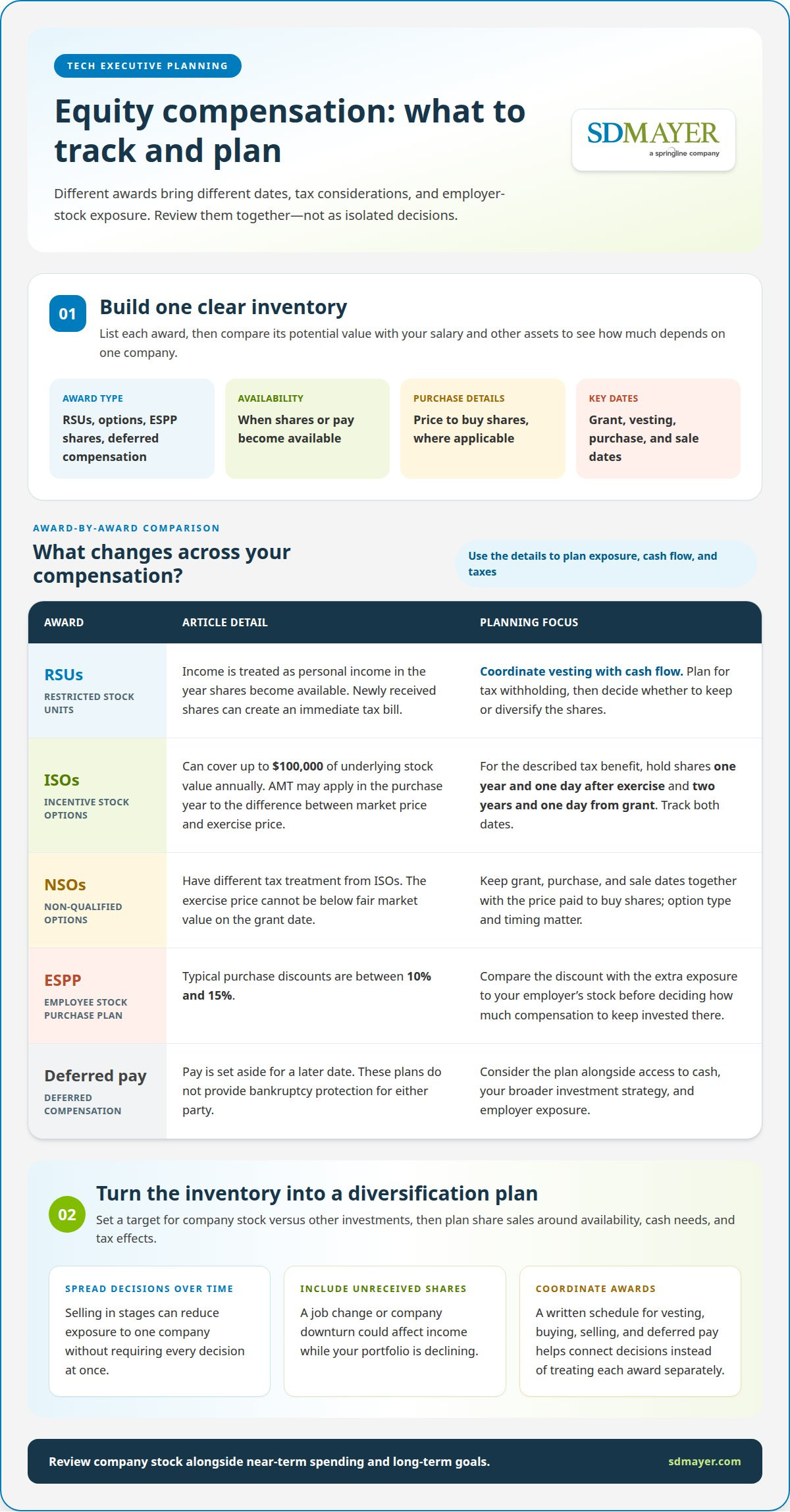
Start by listing restricted stock units (RSUs), stock options, employee stock purchase plan (ESPP) shares, and deferred compensation (pay set aside for a later date). Record each award’s type, when it becomes available, the price you can pay to buy shares, and important dates. Compare the potential value of these holdings with your salary and other assets. This gives you a clearer picture of how much your financial future depends on one company.
Diversifying Concentrated Company Stock
Set a target for how much to hold in company stock versus other investments, then plan sales around the dates shares become available, your cash needs, and tax effects. Selling in stages can reduce your exposure to one company without forcing you to make every decision at once. For example, you could put money from newly available shares into investments outside your employer instead of automatically keeping each share.
Include shares you have not yet received in your risk review. A job change or company downturn could affect your income while your portfolio is declining. Consider how much company stock you can afford to keep while supporting near-term spending and long-term goals.
Taxes on Stock Options
Option type and timing matter. Incentive stock options can cover up to $100,000 of underlying stock value annually, according to the Internal Revenue Service. For these options, the alternative minimum tax, a separate way of calculating tax that may apply in addition to regular income tax, applies to the difference between market price and exercise price in the year you buy the shares.
To qualify for the described incentive stock option tax benefit, shares must be held for one year and one day after exercise and two years and one day from the grant date. Non-qualified options, a different type of stock option, have different tax treatment, so track the grant, purchase, and sale dates alongside the price you pay to buy shares. Their exercise price cannot be below fair market value, or the share’s value, on the grant date.
Planning for Stock-Based Pay
Include RSU dates in your cash-flow and investment plan. Income from RSUs is treated as personal income in the year the shares become available. Newly received RSUs can also create an immediate tax bill, so plan for tax withholding and decide whether to keep or diversify the shares.
Review ESPP purchases alongside RSUs and options. Typical employee stock purchase plan discounts are between 10% and 15%. Compare the discount with the added exposure to your employer’s stock before deciding how much compensation to keep invested in your employer.
Include deferred compensation in the same review. These plans do not provide bankruptcy protection for either party. Consider how the plan fits your broader investment strategy, access to cash, and employer exposure. A written schedule of dates for shares becoming available, buying or selling shares, and receiving deferred pay can help you coordinate decisions rather than treating each award separately.
Choosing an advisor as a Bay Area tech professional
A useful financial advisor should understand how equity compensation, career choices, and long-term goals fit together. Compare advisors based on relevant experience, services, communication style, and how they’re paid, not recognition alone.
Advisor Credentials and Qualifications
Look for experience serving tech professionals and handling equity compensation, concentrated stock, and wealth management. The Forbes Best-In-State Wealth Advisors ranking considers advisors with a minimum of seven years’ experience. Treat recognition as one screening point, then ask how the advisor approaches situations like yours, such as planning around unvested awards or a potential company sale.
Clarify the advisor’s role and how recommendations are delivered. Ask whether the relationship covers investment management alone or broader financial planning, including taxes, cash flow, and retirement goals. Discuss how often you’ll meet, who prepares your plan, and how decisions across those areas are coordinated. A clear process helps you assess whether the advisor can be a practical partner as your circumstances change.
Finding Advisors by Location and Specialization
Search by both location and expertise. San Francisco-area advisors may serve SoMa, the Mission District, Pacific Heights, Noe Valley, the Richmond, and the Sunset. A local address can make in-person meetings easier, while relevant experience matters for questions about startup equity, public-company compensation, or a liquidity event.
For an advisor working across state lines, California registration may be needed. Look for advisors who serve technology professionals and startup employees, then compare their experience with your compensation and goals. An executive approaching an IPO, for example, may need different planning from an employee managing recurring RSU vesting. Consider whether the advisor can address the full picture you want covered.
How an advisor is paid also shapes the relationship. A fee-only advisor is paid directly by clients, rather than earning commissions for selling financial products. San Francisco advisors may charge flat fees, monthly subscriptions, or hourly-session fees. Ask what each arrangement covers, how ongoing support works, and whether investment management is included. Compare the services you’ll receive, not just the payment label.
Before choosing, prepare a short list of priorities: equity awards, investment decisions, tax planning, and retirement timing. Use it to discuss the advisor’s process and identify any gaps. A focused conversation about your advisor priorities can help you decide what expertise your plan needs.
Diversified long-term wealth strategies
California and San Francisco tax considerations can affect how much compensation and investment returns remain available for your goals. Include expected income, equity decisions, and cash needs in the same tax and investment plan. This helps you assess their combined effects instead of treating each investment decision in isolation.
Start by mapping income, investments, planned spending, and major upcoming decisions. Include salary, bonuses, equity awards, retirement accounts, and investments held elsewhere. Then connect each asset to a goal, such as buying a home, meeting family needs, or retiring. This overview can reveal whether your plans rely too heavily on one company, one type of investment, or a future liquidity event.
Tax-aware investing can shape how you build a diversified portfolio. Tax-loss harvesting means selling an investment that has declined in value and including that loss in your tax planning. Asset location means choosing which investments to hold in taxable or retirement accounts. Weigh these approaches against your goals, investment mix, and time horizon rather than treating either as an automatic move.
Coordinate with your certified public accountant (CPA) before decisions that affect taxable income or investment sales. Share an up-to-date summary of compensation, planned transactions, charitable goals, and expected cash needs. Ask your CPA and financial advisor to review the same assumptions, then clarify who handles each decision. This transparent process can connect investment changes with tax planning and help prevent decisions based on different or outdated figures.
Charitable giving can connect your values with your wealth plan. Set a giving goal and timeline that fit your cash flow. Then consider which assets to give and how that choice fits your investment and tax picture. Strategic charitable giving is one tax-aware approach discussed for California high earners. The practical choice depends on your situation, the assets involved, and your other financial priorities.
Include estate goals in the same conversation. Decide who you want your wealth to support, which assets are intended for those goals, and how a company sale could change the plan. An executive anticipating a liquidity event, for example, can model how proceeds might support family priorities, charitable commitments, and investments beyond the former employer. This connects current decisions with the longer-term purpose of your wealth.
Review your plan when compensation, family needs, or career direction changes. Compare your current investments with your goals, revisit tax-aware choices, and identify questions for your CPA. In the San Francisco Bay Area, a coordinated review can keep investment decisions, tax planning, and estate priorities connected as circumstances evolve, without turning each decision into a separate project.
They can reduce the compensation and investment returns available to fund personal goals. Planning for income, equity decisions, investments, and cash needs together can help executives understand their combined effects.
Financial independence and early retirement
Early retirement planning starts by matching expected spending with income, available assets, and family priorities. A comprehensive financial plan should also account for company-related wealth and changes in employment income, so your financial future does not depend on a single assumption.
There isn’t one contribution limit that applies to every 401(k), mega backdoor Roth strategy, and deferred compensation plan. The relevant 401(k) limits depend on current federal rules, while a mega backdoor Roth strategy means moving eligible after-tax workplace-plan contributions into a Roth account, if the plan allows it. Deferred compensation is pay scheduled for a later time, with details set by the plan.
Retirement Timeline Coordination
Work backward from your preferred retirement date. Estimate essential spending, discretionary goals, and income sources for each stage, then compare them with accessible investments and retirement accounts. Someone leaving work before relying on retirement accounts, for example, may need a plan to cover expenses during the years before those funds are accessible.
Coordinate the timeline with your partner and family. Include housing, education goals, caregiving, and plans to support relatives. If one partner expects to keep working, account for that income separately rather than assuming you will both retire together. Revisit the plan when a promotion, job change, or compensation shift changes the household outlook.
401(K), Roth, and Deferred Compensation Limits
Contribution limits and options depend on current federal rules and your employer’s plan terms. A mega backdoor Roth strategy uses eligible after-tax contributions to build Roth savings, but the plan must allow the relevant steps. Deferred compensation lets an employee receive some pay later, and its distribution terms determine when that income becomes available.
For California retirement planning, project cash flow after taxes instead of treating account balances as immediately spendable income. Coordinate your assumptions with your tax professional and review how contributions and future distributions fit your expected income, location, and retirement timing.
Build a retirement model with separate scenarios for continued employment, a planned departure, and a compensation change. Compare income, spending, savings, and investment needs in each scenario. A departure plan can be sensitive to employer performance when company wealth is involved, so test different outcomes instead of relying on one expected value.
Next, map which resources will support each stage of retirement. Consider cash for near-term spending, investments for longer-term goals, and the timing of expected pay. This separates funds for immediate needs from savings that can remain invested for future use.
If you are approaching retirement, review workplace benefits that may change when employment ends. List the benefits your household relies on, identify ongoing expenses, and include replacement costs in your spending plan. Discuss these choices with your partner before settling on a departure date.
Schedule regular reviews around meaningful changes, such as a new role, family needs, or a possible liquidity event. Update spending assumptions and retirement timing together. A plan that connects household priorities, available funds, and investment decisions can make the path toward financial independence clearer.
Initial public offering (IPO), business sale, and liquidity-event planning
An IPO or business sale can change the form of your wealth, but it does not automatically make every share available to sell. Prepare by mapping your equity, expected transaction milestones, cash needs, and career plans before the event. This helps you assess how company proceeds could support retirement and other priorities.
Begin by inventorying stock options, shares, and other compensation tied to your employer. Record grant and vesting details, exercise prices, and any dates or conditions that affect your decisions. Then model different outcomes, such as a transaction delay, sale, or public listing. For each, consider how your income, available cash, and investment mix might change. Avoid building your entire plan around one expected company valuation.
Next, separate decisions that need attention before a transaction from those that come afterward. Identify the cash required for taxes, near-term spending, and planned purchases. Decide how much of any proceeds you want to keep in company stock and how much could support other goals. A written plan can help prevent a sudden change in paper wealth from driving rushed decisions about housing, gifts, or retirement.
Leaving a tech company or relocating can affect the timing and coordination of equity decisions, income, and tax planning. Before a move or departure, organize award records, vesting schedules, employer documents, and expected income dates. Then model how different timing scenarios fit your career and retirement plans, and coordinate tax questions with your tax professional.
For a business sale, include the company’s financial picture in your personal planning. Owners can map expected proceeds against business obligations, future income, and succession goals. For an IPO, distinguish shares you may be able to sell from holdings that remain subject to company or transaction conditions. In either case, a clear timeline helps you navigate decisions without assuming all equity becomes liquid at once.
After the event, revisit your investment plan before making major purchases or changing your career. Compare actual proceeds and tax estimates with your prepared scenarios. Then set priorities for cash reserves, diversified investments, family goals, and retirement. Managing stock after a liquidity event is an ongoing decision, not a one-time sale.
Prepare a concise transaction summary with your equity records, expected dates, income needs, and questions for your tax and financial professionals. Discuss liquidity-event planning as you organize the financial decisions around a potential IPO or business sale.
SD Mayer: Employee benefit plan audits
SD Mayer provides Employee Benefit Plan Audits for organizations that need an independent review of their benefit plan. This support may be relevant as your company grows or its financial reporting needs change. For broader operational support, SD Mayer also offers Client Accounting & Advisory Services (CAAS) and Outsourced CFO/Controllers.
If your organization is assessing audit needs, preparing financial information, or coordinating reporting across a growing business, consider what support fits the task. SD Mayer also provides Single Audits for organizations with that specific audit need. A clear understanding of your reporting and audit requirements can help identify the next practical step.
Contact SD Mayer to discuss employee benefit plan audits and related financial support.
Make your next financial decision part of the bigger plan
Your next career or company decision can shape more than your investment portfolio. Before acting, define what you want your finances to make possible, then use that priority to guide choices about work, family, and future commitments. A clear objective gives each decision purpose, even as circumstances change.
Financial planning for tech executives in San Francisco can involve business needs alongside personal goals. If company reporting or audit support is part of your next step, SD Mayer offers Client Accounting & Advisory Services (CAAS), Outsourced CFO/Controllers, and Single Audits. These services address business needs that may sit alongside your personal financial decisions.
Choose one priority to move forward now, such as organizing a major decision or aligning your business and personal planning. Contact SD Mayer to discuss your plans and identify a practical next step. Thoughtful planning can help you move ahead with greater clarity and confidence.
Frequently Asked Questions
Why do tech professionals have unique financial needs?
Tech professionals often need to coordinate changing pay, company shares, and personal goals. A promotion, startup role, or company sale can affect income and financial choices at different times. If you’re considering a job change, for example, weigh unvested awards alongside household spending and career plans. A useful plan connects work decisions with life priorities instead of treating each choice separately.
What credentials should I look for in a San Francisco investment advisor?
Look for relevant experience, a clear planning process, and familiarity with technology compensation. Forbes Best-In-State Wealth Advisors rankings consider advisors with a minimum of seven years’ experience, which can be one screening reference. Also consider whether an advisor explains recommendations clearly and addresses your priorities, such as investments, retirement, and taxes. Ask how often you’ll communicate and which decisions the advisor will help with.
What financial planning services do tech executives in San Francisco typically need?
Financial planning for tech executives in San Francisco may bring together investment management, planning for taxes on company shares, and retirement planning. Founders may also need to connect personal goals with business decisions, while employees may focus on compensation and investments. SD Mayer offers stock option tax planning, financial planning, and wealth management. List the decisions you want help coordinating, then shape a plan around your circumstances.
How should tech executives manage restricted stock units (RSUs), stock options, and concentrated employer stock?
Include workplace awards in your overall financial picture. Record each award’s type, vesting or exercise details, and upcoming decision dates. Before acting, consider how your choice affects available cash and how much you rely on employer stock. For example, review an upcoming award alongside planned household spending or a possible career move. This context can help you make a deliberate choice instead of reacting to a share-price change.
What are the tax implications of exercising ISOs or NSOs in California?
ISOs are incentive stock options; NSOs are non-qualified stock options, and their tax treatment differs. Exercising an incentive stock option can trigger the alternative minimum tax, a separate tax calculation based on the difference between the stock’s market price and exercise price in the exercise year. The described tax benefit also depends on meeting holding periods. Review your grant and exercise details with your tax professional before deciding when to exercise.
How should executives plan for liquidity events, IPOs, or selling startup equity?
Prepare by organizing equity records, estimating cash needs, and considering different transaction outcomes. An IPO and a business sale can involve different timelines, so don’t assume all shares will be available to sell at once. Consider how proceeds may support taxes, family priorities, and future investments. After a transaction, compare actual proceeds with your plan before making major purchases or changing your career direction.
How should San Francisco tech executives plan for housing costs, mortgages, and financial independence?
Connect housing choices to household cash flow and long-term goals. Consider mortgage payments and other home expenses alongside dependable income, savings, and family priorities. Avoid relying entirely on company shares or a future liquidity event to make a home affordable. Test whether the budget still works if expected proceeds arrive later than planned. This can help balance a home purchase with retirement goals and other commitments.
SECURITIES AND ADVISORY DISCLOSURE:
Securities offered through Valmark Securities, Inc. Member FINRA, SIPC. Fee based planning offered through SDM Advisors, LLC. Third party money management offered through Valmark Advisers, Inc a SEC registered investment advisor. 130 Springside Drive, Suite 300, Akron, Ohio 44333-2431. 1-800-765-5201. SDM Advisors, LLC is a separate entity from Valmark Securities Inc. and Valmark Advisers, Inc. Form CRS Link
DISCLAIMER:
This material has been prepared for informational purposes only, and is not intended to provide, and should not be relied on for, accounting, legal or tax advice. The services of an appropriate professional should be sought regarding your individual situation.
HYPOTHETICAL DISCLOSURE:
The examples given are hypothetical and for illustrative purposes only.