
Imagine watching your company's valuation climb toward a billion dollars, but instead of celebrating, you're paralyzed by the thought of a seven-figure tax bill waiting at the finish line. It's a heavy weight to carry when you should be focused on your career growth. We understand that the complexity of early exercise stock options tax implications can feel like a high-stakes gamble, especially when you're balancing the fear of a massive tax hit against the risk of the company's future performance.
You've worked hard for your equity, and you deserve a strategy that protects it. Our goal is to help you master the tax advantages of early exercising to maximize your long-term wealth in 2026. We'll show you how to lock in low valuations and start the clock on significant tax-free gains. It's about moving from anxiety to a clear, actionable plan for your financial future.
In this guide, we'll break down the critical 30-day 83(b) election deadline and explain how the 2026 AMT exemption limits of $90,100 for single filers impact your strategy. You'll learn exactly how to use the Qualified Small Business Stock rules to potentially secure millions in tax-free growth. We're here to guide you through every step of your 2026 tax filing with confidence and precision.
Key Takeaways
- Learn how to start the clock on long-term capital gains and potential tax-free growth by exercising your options before they officially vest.
- Understand the early exercise stock options tax implications to avoid the "AMT trap" and ensure you aren't overpaying as the company's value grows.
- Master the critical 30-day window for filing your 83(b) election, a non-negotiable step to lock in your tax basis at the lowest possible valuation.
- Evaluate the balance between upfront cash risk and the long-term rewards of Qualified Small Business Stock (QSBS) eligibility.
- Discover how to align your equity exercise strategy with California’s specific tax laws to protect your wealth through holistic financial planning.
What Is Early Exercise and Why Does It Matter for Your Taxes?
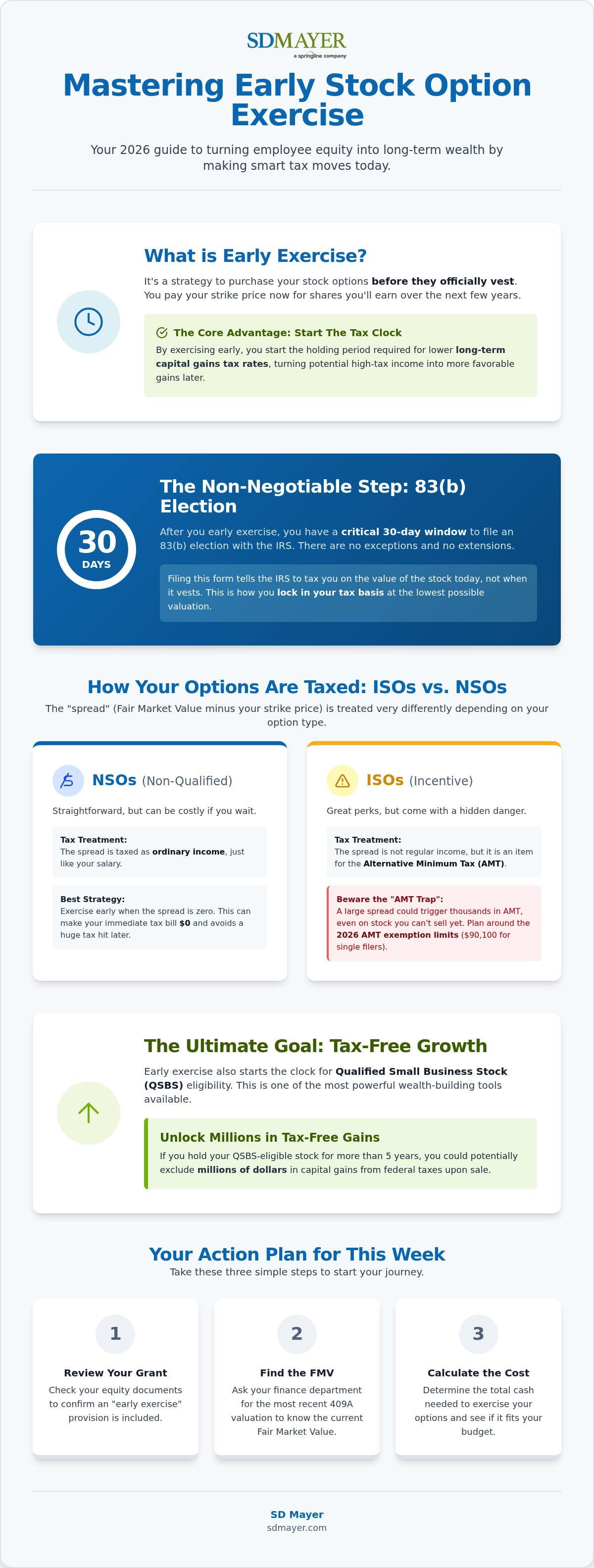
Early exercise is a strategy that allows you to purchase your stock options before they have officially vested. In a traditional equity setup, you wait for your "cliff" or monthly vesting dates to pass before you have the right to buy your shares. Early exercise flips this model. You pay your strike price now for shares you'll technically "earn" over the next few years. This decision is rarely about the stock itself and almost always about the early exercise stock options tax implications that follow.
For professionals in San Francisco and San Jose, 2026 is a pivotal year for this type of planning. With the federal income tax brackets adjusted for inflation and the AMT exemption sitting at $90,100 for single filers, the window to lock in lower tax rates is shifting. By exercising early, you are essentially betting that the company's value will be much higher in the future, and you want to pay your tax bill based on today's lower price rather than a sky-high valuation later.
Vested vs. Unvested: Understanding the Shift
When you exercise early, the shares you receive are considered "restricted stock." While you technically own them, they remain subject to your original vesting schedule. It's vital to understand that if you leave your company before these shares would have naturally vested, the firm usually maintains a "repurchase right." This means they can buy back your unvested shares at the original price you paid. You aren't losing your cash, but you are losing the opportunity for those shares to grow. This is why we often view early exercise as a partnership between your career path and your financial goals.
The Core Advantage: Starting the Tax Clock
The primary reason to consider this move is to start the clock on your holding periods. To qualify for lower long-term capital gains rates, you typically need to hold your stock for more than one year after exercise. When you deal with Incentive Stock Options (ISOs), early exercise allows that one-year holding period to begin immediately, even while the shares are still unvested.
This sets your "cost basis" at today's Fair Market Value (FMV). If you wait to exercise until the company is worth significantly more, you might find yourself trapped by a massive tax bill. By acting early, you aim to minimize the "spread" between your strike price and the FMV. This is a foundational step in holistic wealth management, as it turns potential high-tax ordinary income into much friendlier long-term gains down the road.
- Review your equity grant documents to see if an "early exercise" provision is included.
- Request the most recent 409A valuation from your finance department to determine the current FMV.
- Calculate the total cost required to exercise your unvested options to see if it fits your current cash flow.
Tax Implications: Breaking Down ISOs vs. NSOs
The most critical concept to grasp when looking at early exercise stock options tax implications is "the spread." This is simply the difference between your strike price, which is the amount you pay for the stock, and the current Fair Market Value (FMV). If your strike price is $1.00 and the FMV is $1.00, your spread is zero. If you exercise at this exact moment, you technically haven't received any immediate financial gain in the eyes of the IRS. This is why exercising immediately upon receiving your grant is often the most tax-efficient move; it can effectively bring your tax bill for the exercise down to $0.
The IRS views early exercise as an acquisition of restricted property. Because you are buying shares that haven't vested yet, you are locking in your tax basis at today's price. If the company's value explodes later, you've already "paid your dues" on the initial acquisition. However, the type of options you hold determines how that spread is treated. Getting strategic tax advice before you sign any paperwork is vital to ensure you don't accidentally trigger a bill you aren't prepared to pay.
Non-Qualified Stock Options (NSOs) and Ordinary Income
NSOs are straightforward but can be expensive if you wait. The IRS treats the spread on NSOs as supplemental wages, which means it's taxed at ordinary income rates. When you exercise, your company is required to withhold taxes just like they do with your regular paycheck. If you exercise early when the spread is zero, there is nothing to withhold. This prevents a massive tax hit later when the shares vest at a much higher valuation. It's a proactive way to keep more of your future gains in your own pocket.
Incentive Stock Options (ISOs) and the AMT Trap
ISOs offer significant tax perks, but they come with a hidden danger known as the Alternative Minimum Tax (AMT). While you don't owe regular income tax when you exercise ISOs, the spread is considered an "adjustment item" for AMT purposes. If your spread is large, you could find yourself owing thousands in taxes for stock you can't even sell yet. The Alternative Minimum Tax functions as a shadow tax system for high earners, ensuring a minimum level of tax is paid regardless of standard deductions. By exercising early with a $0 spread, you bypass this trap entirely, as there is no gain to report to the AMT system.
Every equity situation is unique, and the right path depends on your specific financial picture. If you want to ensure your exercise strategy is optimized for your long-term goals, you might want to speak with a tax professional who understands the nuances of Bay Area equity.
- Identify whether your grant consists of ISOs, NSOs, or a combination of both.
- Check your payroll portal to see how your company handles tax withholding for equity events.
- Compare your strike price to the current 409A valuation to calculate your potential spread.
The 83(b) Election and Qualified Small Business Stock (QSBS)
If you've decided to exercise your options early, the 83(b) election is your most powerful tool. Think of it as a "magic button" that tells the IRS you want to be taxed on your shares today based on their current value, rather than waiting for them to vest in the future. By doing this, you effectively "freeze" your tax liability. If the stock is worth $1.00 today and climbs to $50.00 by the time it vests, the IRS only cares about that initial $1.00. This is a cornerstone of managing early exercise stock options tax implications because it prevents your future tax bill from growing alongside your company's success.
There is a significant catch that catches many professionals off guard. You must file this election with the IRS within exactly 30 days of your exercise date. This deadline is absolute. There are no extensions, and the IRS does not allow for "do-overs" if you forget. If you miss this window, you lose the ability to lock in your tax basis, and you'll likely face a much higher tax bill at ordinary income rates every time a new batch of shares vests at a higher price.
Filing Your 83(b) Election in 3 Steps
Filing shouldn't be intimidating, but it does require precision. First, complete the IRS form accurately; even a small typo in your social security number or the number of shares can cause issues later. Second, mail the original form to the IRS via certified mail with a return receipt requested. This receipt is your only legal proof that you met the 30-day deadline. Finally, notify your employer by providing them with a copy of the filed form and keep a digital version in your permanent tax records for when you eventually sell the stock.
Maximizing the QSBS Benefit
Another reason to exercise early is to start the five-year holding period for Qualified Small Business Stock (QSBS). Under Section 1202, you could potentially exclude the greater of $15 million or 10 times your basis in gains from federal tax. For stock acquired after July 4, 2025, the company's gross assets must not exceed $75 million at the time of issuance to qualify. Exercising early is often the only way to start this clock while the company still meets these specific asset requirements, potentially leading to millions in tax-free wealth down the road.
- Set a calendar reminder for 25 days after your planned exercise date to ensure your 83(b) is in the mail.
- Confirm with your company's CFO or legal team if the business currently meets the $75 million gross asset threshold for QSBS.
- Print two copies of the 83(b) election form so you have one for the IRS and one for your own files.
Weighing the Risks: Is Early Exercise Right for You?
Deciding to exercise your options early is essentially a high-stakes bet on your company's future success. While the potential rewards are significant, you must look closely at the risks involved. You are putting "cash at risk" by spending real money today for stock that may never become liquid. If the company struggles or the market shifts, that capital could be lost entirely. Understanding the early exercise stock options tax implications means acknowledging that you might pay taxes on a valuation that later disappears.
There is also the forfeiture risk to consider. If you leave the company before your shares officially vest, the firm typically has the right to buy back those unvested shares at your original strike price. While you get your initial investment back, you lose the potential for any growth. Before making a move, it's wise to consult a tax accountant who can help you model different exit scenarios and determine if the risk aligns with your broader financial goals.
The Financial Risk of Private Equity
Owning private company stock is very different from owning shares in a public company. Even after you exercise, you are often subject to a "lock-up" period, which prevents you from selling your shares for a set amount of time after an IPO. Illiquidity in the context of Bay Area startup stock means you own a valuable asset on paper that cannot be sold or traded for cash until a specific "liquidity event," such as an acquisition or a public offering, occurs. You could be "paper wealthy" for years without having the cash to pay for a mortgage or a child's tuition.
The Opportunity Cost of Capital
Every dollar you spend on exercising options is a dollar that isn't working for you elsewhere. In 2026, with interest rates and market returns constantly shifting, you have to ask if that capital would be better served in a diversified portfolio. For mid-market employees, over-concentrating your wealth in a single company's stock is a gamble. If the company fails, you lose both your job and your savings. Diversifying your investments ensures that your financial security isn't tied entirely to one entity's performance.
Modeling these risks is a complex process that requires a deep understanding of your personal tax situation. If you're ready to build a strategy that protects your downside while capturing the upside, reach out to our team today for a personalized equity review.
- Review your "lock-up" agreement to understand when you'll actually be allowed to sell shares after an IPO.
- Calculate what percentage of your total net worth would be tied up in company stock if you exercised all your options today.
- Determine your "risk-free" alternative by looking at current high-yield savings or index fund returns for 2026.
Strategic Planning for Bay Area Professionals
Living and working in the Bay Area brings unique financial opportunities, but it also comes with some of the most complex tax landscapes in the country. When you're evaluating the early exercise stock options tax implications, you can't just look at federal rules. California has its own way of doing things, and if you aren't prepared, the state's 13.3% top tax bracket can take a significant bite out of your hard-earned equity. Unlike the federal government, California doesn't offer a lower tax rate for long-term capital gains; it treats that income the same as your regular salary. This complexity is why many serious investors turn to Obsidian Wealth Management for advanced wealth architecture that accounts for both state and federal tax nuances.
For residents in San Francisco and San Jose, having a robust SALT deduction strategy is essential. Since you're likely already hitting the federal cap on state and local tax deductions, every dollar you save through smart equity timing matters more. Integrating your stock options into a holistic wealth management plan ensures that your exercise strategy isn't just a tax move, but a step toward your broader life goals, like buying a home or planning for retirement.
California State Tax Nuances
California's treatment of ISOs is a common pitfall for many tech professionals. While the federal government gives you a break on ISOs if you meet specific holding periods, California often taxes the "spread" as ordinary income when you eventually sell. This makes the timing of your exercise even more critical to avoid a double hit. You also need to account for standard deductions and how a large equity event might push you into a higher effective tax rate for the 2026 tax year. Planning for these nuances today prevents a stressful surprise when it's time to file.
How SD Mayer Optimizes Your Equity Portfolio
At SD Mayer, we serve as a steady companion for executives from Santa Rosa to Walnut Creek and beyond. We don't just look at the numbers for your next filing; we look at the big picture of your financial journey. Our goal is to move you beyond simple compliance into a proactive equity strategy that anticipates market shifts and regulatory changes. We understand the nuances of a fast-paced regional economy and provide the calm, capable stewardship needed to manage complex equity events successfully.
- Schedule an equity review with a professional before your next grant date or major vesting cliff.
- Update your 2026 tax projections to include potential state tax liabilities from your stock options.
- Review your current state of residency and any planned moves, as California's "clawback" rules can sometimes apply to equity earned while working in the state.
Take Control of Your Equity Future in 2026
Mastering your equity isn't just about understanding the mechanics of a grant; it's about making proactive decisions that protect your wealth for years to come. For high-income professionals, this often includes coordinating with Retirement Roadmap Experts to ensure that equity windfalls are integrated into a comprehensive retirement income strategy. By locking in a low cost basis today and strictly adhering to the 30-day 83(b) filing window, you can transform potential high-tax ordinary income into significant tax-free gains. Managing the early exercise stock options tax implications requires a careful balance of risk and reward, especially when considering California's unique state tax landscape and the power of QSBS eligibility.
You don't have to handle these complex decisions alone. Our team provides specialized stock option planning and integrated wealth management tailored specifically for the Bay Area market. We're here to serve as your steady companion, ensuring your strategy is optimized for the long term. If you're ready to move forward with confidence, optimize your stock option strategy with SD Mayer’s expert tax team. Your future self will thank you for the clarity and security you build today.
Frequently Asked Questions
What happens if I miss the 83(b) election deadline?
If you miss the 30-day deadline, the mistake is generally irreversible and you lose the ability to lock in your tax basis. This means you'll be taxed at ordinary income rates on the difference between your strike price and the stock's value every time a portion of your shares vests. It's a costly error that can lead to massive tax bills if the company's valuation grows quickly. Always use certified mail to prove you met the window.
Can I early exercise my stock options if my company is still private?
You can early exercise in a private company as long as your specific equity incentive plan includes an early exercise provision. Most early-stage startups offer this feature to help employees manage their future tax liabilities. It's a common strategy for Bay Area professionals who want to own their shares outright before an IPO. Check your grant agreement or ask your HR department to confirm if this option is available to you.
How much does it cost to file an 83(b) election with the IRS?
There is no filing fee to submit an 83(b) election to the IRS. Your only direct costs will be the postage for sending the form via certified mail with a return receipt requested. While the filing itself is free, many professionals choose to work with a tax advisor to ensure the form is completed accurately. A single typo can cause significant headaches when you eventually sell your shares years down the road.
Is early exercise better for ISOs or NSOs?
Both types of options benefit from this strategy, but the early exercise stock options tax implications are often more favorable for ISO holders. Exercising ISOs early when the spread is zero helps you avoid the Alternative Minimum Tax (AMT) entirely. For NSOs, exercising early locks in your ordinary income tax at a lower valuation, which can lead to substantial savings if the stock price increases before you eventually sell your shares.
What is the biggest risk of early exercising stock options?
The biggest risk is the potential loss of your personal capital if the company fails or its valuation drops. When you exercise early, you're spending real money to buy shares that aren't yet liquid. If the company doesn't reach a successful exit, like an acquisition or IPO, you won't be able to get that cash back. You also risk paying taxes upfront on a stock value that could eventually disappear.
Do I have to pay California state tax when I early exercise?
You will owe California state tax at the time of exercise if there is a difference between your strike price and the current fair market value. California treats this "spread" as ordinary income, and the state's top tax rate reaches 13.3%. If you exercise immediately upon receiving your grant when the spread is zero, you can often avoid an immediate state tax bill. This is a key part of local tax planning for Bay Area residents.
Can I get my money back if the company fails after I exercise?
No, you generally cannot get your money back from the company if it fails after you've exercised your options. Once you buy the shares, you're a shareholder and subject to the same investment risks as any other owner. The only time you typically get your money back is if you leave the company before vesting and the firm chooses to repurchase your unvested shares at the original price you paid for them.
How does early exercise help with the QSBS 5-year holding period?
Early exercise is the only way to start the five-year QSBS holding period clock for shares that haven't vested yet. Normally, the clock doesn't start until you actually own the stock. By exercising early and filing an 83(b) election, the IRS considers you the owner for tax purposes immediately. This allows you to meet the five-year requirement much sooner, potentially qualifying you for millions in tax-free gains when you eventually sell your shares.
SECURITIES AND ADVISORY DISCLOSURE:
Securities offered through Valmark Securities, Inc. Member FINRA, SIPC. Fee based planning offered through SDM Advisors, LLC. Third party money management offered through Valmark Advisers, Inc a SEC registered investment advisor. 130 Springside Drive, Suite 300, Akron, Ohio 44333-2431. 1-800-765-5201. SDM Advisors, LLC is a separate entity from Valmark Securities Inc. and Valmark Advisers, Inc. Form CRS Link
DISCLAIMER:
This material has been prepared for informational purposes only, and is not intended to provide, and should not be relied on for, accounting, legal or tax advice. The services of an appropriate professional should be sought regarding your individual situation.
HYPOTHETICAL DISCLOSURE:
The examples given are hypothetical and for illustrative purposes only.