
Did you know that nearly half of profitable corporations in California pay only the minimum $800 state tax? While that figure might sound surprising given our state's reputation for high costs, it highlights the massive gap between businesses that simply react to tax season and those that leverage proactive corporate tax planning strategies. For a scaling company in the Bay Area, the difference often comes down to how early you start looking at the big picture.
We understand that managing surprise liabilities at year-end or untangling the web of SALT rules can feel like a full-time job. It's frustrating to watch your cash flow become unpredictable because of complex employee stock options or shifting federal regulations. You deserve a financial partner who acts as a steady guide rather than just a number-cruncher. We'll help you transform tax compliance from a seasonal headache into a genuine competitive advantage.
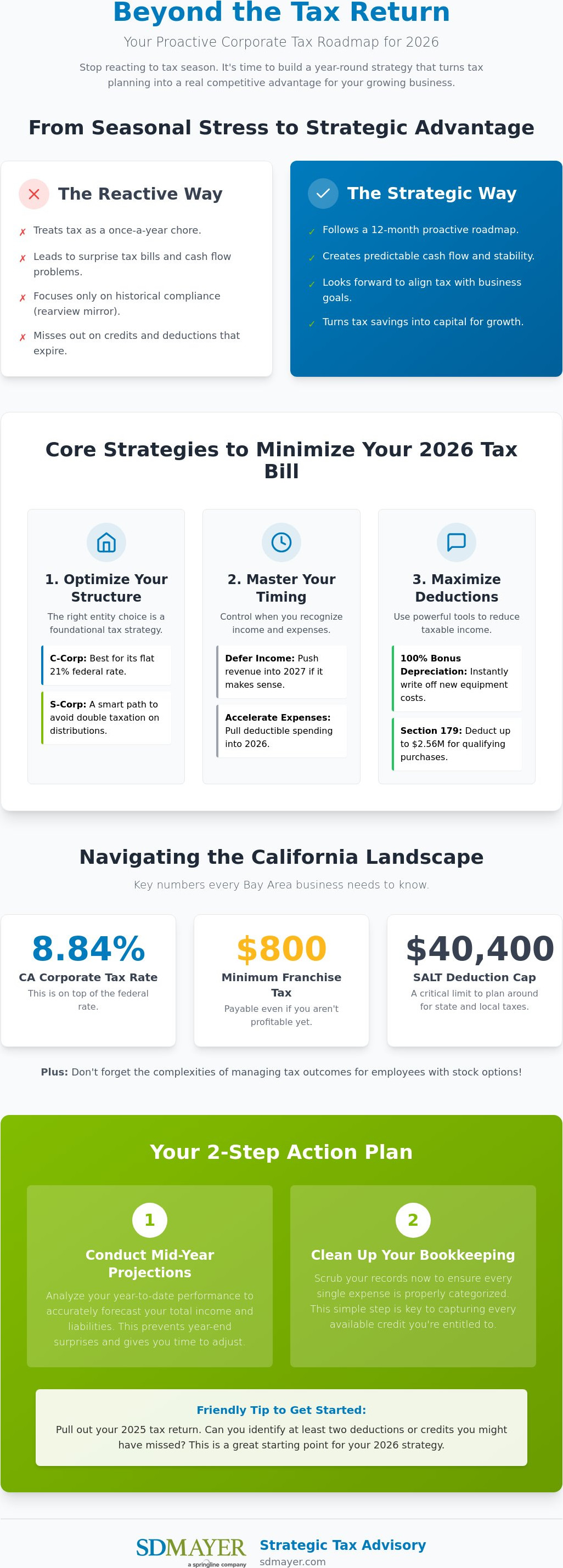
In this guide, we'll outline a clear path for the 2026 tax year. You'll learn how to maximize available credits, navigate the $40,400 SALT deduction cap, and utilize 100% bonus depreciation to keep more capital in your company. Let's build a strategy that provides the stability and growth your vision requires.
Key Takeaways
- Move beyond seasonal stress by adopting a year-round tax roadmap that keeps your cash flow steady and predictable.
- Explore how effective corporate tax planning strategies like income shifting and entity selection can protect your bottom line in 2026.
- Master California-specific challenges, including managing the SALT deduction cap and optimizing tax outcomes for employees with stock options.
- Get a clear, two-step plan for mid-year projections and bookkeeping cleanup to capture every available credit before the year ends.
- Learn why a partnership with a local advisor can transform complex compliance into a strategic advantage for your scaling business.
Beyond the Tax Return: Why Corporate Tax Planning is a Year-Round Strategy
Many business owners view taxes as a seasonal hurdle to clear every spring. However, treating tax as a once-a-year chore often leads to the "Surprise Tax Bill" trap. This happens when you realize too late that your successful year resulted in a massive liability you haven't budgeted for. True corporate tax planning strategies function as a proactive, 12-month roadmap. By maintaining monthly oversight, you ensure that your tax obligations never catch you off guard. It's about understanding tax avoidance in a legal, strategic way that keeps more cash in your business for 2026. This approach allows you to treat tax as a variable you can manage, rather than a fixed cost you simply accept.
Every major business decision should be viewed through a tax lens. If you're planning a large equipment purchase in 2026, the timing of that buy can drastically change your taxable income. Similarly, hiring plans or changes in your business structure can open doors to new credits. Without a year-round plan, these opportunities often expire before you even realize they existed. When you align your tax goals with your operational moves, you create a more stable foundation for growth. It gives you the freedom to focus on innovation instead of worrying about the next IRS notification.
The Difference Between Tax Compliance and Tax Strategy
Compliance is essentially looking in the rearview mirror. It focuses on historical reporting and making sure you meet deadlines. While a talented bookkeeper is vital for keeping clean records, they might miss the big-picture opportunities that a dedicated advisor identifies. Strategy is forward-looking. It aligns your financial decisions with your 2026 growth goals. A forward-thinking strategist looks at upcoming hurdles, like scaling your team or expanding your footprint, and plans for the tax implications before they happen. This shift in perspective turns your tax return from a historical document into a blueprint for future success.
The Financial Impact of Proactive Planning
When you plan early, you can reinvest cost savings directly back into your company. This isn't just about saving money; it's about predictable cash flow. If you know exactly what your tax burden looks like months in advance, you can make confident decisions about equipment buys or new hires. Proactive corporate tax planning strategies also reduce the stress of potential audits. When your records are already aligned with a clear strategy, you aren't scrambling to justify expenses after the fact. This steady, intentional movement ensures that every dollar is working toward your long-term vision.
Core Strategies to Minimise Liability: Structure, Timing, and Credits
Choosing how your business is organized isn't just a legal formality. It's one of the most impactful corporate tax planning strategies you can implement for the 2026 tax year. For many, C-Corporations remain attractive due to the flat 21% federal tax rate. However, as you scale in San Francisco or San Jose, an S-Corp election might be the better path to avoid double taxation on your distributions. Staying current with IRS guidelines for corporations is essential, as the right choice depends entirely on your projected growth and exit strategy. While the federal rate is flat, remember that California adds an 8.84% corporate tax rate on top of that. Even if you aren't profitable yet, you'll still face the $800 minimum franchise tax.
Timing is your next powerful lever. If you're expecting a highly profitable 2026, you might choose to accelerate your deductible expenses into this year while deferring some income into 2027. This is where Section 179 becomes a game-changer. For 2026, you can deduct up to $2,560,000 for qualifying equipment purchases immediately, rather than spreading that deduction over several years. With bonus depreciation at 100% for the year, the potential for immediate tax relief is significant. Using these corporate tax planning strategies effectively allows you to fuel your company's growth using capital that would otherwise be lost to taxes.
Selecting the Optimal Business Structure
As your business evolves, your entity needs change. An LLC offers simplicity in the early days, but a C-Corp might be necessary if you're seeking venture capital or planning an eventual public offering. Multi-entity structures can also provide layers of protection and tax efficiency for diverse business lines. If you're unsure if your current setup still fits your trajectory, consider discussing your entity structure with a strategist to see if a change could lower your overall burden.
Unlocking Hidden Tax Credits
Navigating the California Landscape: SALT and Stock Option Optimization
Running a business in the San Francisco Bay Area comes with undeniable perks, from the deep talent pool to the unrivaled venture capital ecosystem. However, it also means dealing with one of the most demanding tax environments in the country. California's tax system currently ranks 48th in overall state competitiveness. That's a challenging statistic, but it doesn't mean you're stuck with an unmanageable bill. Smart corporate tax planning strategies help you navigate local hurdles like the 8.84% corporate tax rate and the $800 minimum franchise tax while keeping your growth on track.
One of the biggest shifts for 2026 is the updated State and Local Tax (SALT) deduction cap. For single filers and married couples filing jointly, this cap has risen to $40,400. While this is a significant step up from previous years, it often still falls short for high-earning business owners in San Jose or San Francisco. Beyond federal caps, you should also look into the "California Competes" tax credit. This is an income tax credit available to businesses that want to stay and grow in California. It's a competitive process, but for scaling firms, the savings can be substantial. If you're expanding beyond California, watch out for state nexus issues. Doing business across state lines can trigger new tax obligations in places you didn't expect, requiring careful coordination to avoid double taxation.
Winning the SALT Game in California
If you're a pass-through entity owner, the $40,400 cap can feel like a ceiling on your success. This is where the Pass-Through Entity (PTE) tax election becomes a vital tool. By electing to pay state taxes at the entity level, you can effectively bypass the individual SALT cap. It's a complex move that requires precise timing, but it’s one of the most effective ways to lower your total tax burden for 2026. Action Item: Schedule a call with your advisor this week to ask if a PTE tax election is appropriate for your specific business structure.
Stock Options: A Strategic Benefit, Not a Tax Burden
In the tech-heavy Bay Area, stock options are a primary way to attract top talent. However, without careful management, Incentive Stock Options (ISOs) can trigger the Alternative Minimum Tax (AMT) trap. This can leave employees or founders with a huge tax bill on paper gains they haven't actually cashed out yet. Integrating your payroll with your tax planning is essential here. You need to coordinate the timing of exercises and sales to ensure liquidity is available when the tax bill arrives. Whether you're planning for an IPO or a smaller liquidity event, having a roadmap for your equity compensation is non-negotiable.
Building Your Tax Roadmap: Actionable Steps for Scaling Businesses
Many business owners treat taxes like a fire drill. They wait until the final weeks of December to look at their numbers, only to find they have very few options left to lower their liability. Building a roadmap for 2026 requires shifting that mindset. It's about taking small, intentional steps throughout the year so that tax season becomes a non-event. Effective corporate tax planning strategies rely on high-quality data and frequent communication between you and your advisory team.
Your roadmap should start with a mid-year tax projection. By June or July, you'll have enough data to see where your annual profit is heading. This is the perfect time to decide if you need to pull forward equipment buys to utilize the $2,560,000 Section 179 deduction limit. From there, focus on cleaning up your bookkeeping. If your records are messy, you're likely missing small, everyday deductions that significantly impact your bottom line. We recommend meeting with your outsourced CFO or tax advisor at least once a quarter. A lot can change in 90 days. These check-ins allow for "course corrections" before the calendar turns. Finally, ensure your personal wealth management is in sync with your corporate strategy. Your business is likely your largest asset, so these two worlds must talk to each other to maximize your long-term success.
Integrating Tax Planning into Your Monthly Workflow
Tax planning shouldn't feel like a separate project. It works best when it's baked into your monthly financial routine. This is where What is CAAS? becomes a game-changer for scaling firms. Client Accounting Advisory Services provide the real-time visibility you need to make smart moves. An outsourced controller can monitor your transactions for tax sensitivity, ensuring every expense is categorized correctly from day one. This constant oversight means you're always "tax-ready" rather than scrambling at the 11th hour.
Preparing for Audits Before They Happen
No one likes an audit, but being prepared makes the process much smoother and less stressful. For businesses that receive federal funding or offer robust retirement packages, Single Audits or Employee Benefit Plan audits are often a requirement. These specialized reviews need expert oversight to ensure every regulation is met. Clean, digital documentation is your best defense. Action Item: Set up a centralized digital repository for all tax-related receipts, contracts, and legal documents today to ensure your returns are bulletproof.
Ready to build a more predictable financial future? Contact our team today to start designing a tax roadmap tailored to your 2026 business goals.
Partnering for Growth: How Strategic Advisory Transforms Your Bottom Line
At SD Mayer, we believe that the best financial advice comes from a deep understanding of your journey. It isn't enough to just look at a spreadsheet. You need a partner who sees the person behind the numbers. Our approach combines high-level professional authority with a supportive, partnership-oriented undertone. We've spent years in the San Francisco Bay Area helping scaling businesses thrive in a fast-paced regional economy. This local expertise is vital. The rules that apply in other states often don't work here. When you implement corporate tax planning strategies, you aren't just checking a box for the IRS. You're building a foundation for your company's next decade.
We see ourselves as a steady companion through the various stages of your business growth. This means we're here to reduce the stress of complex compliance by projecting an image of calm, capable stewardship. We don't just provide a service; we invest in your success. Whether you're a startup founder in San Jose or a long-standing firm in San Francisco, you deserve an advisor who is as agile and modern as the market you operate in. Relationships matter as much as accuracy.
The Value of a Holistic Mentor
A holistic mentor looks at the big picture of your financial health. Instead of treating payroll, wealth management, and tax as separate silos, we integrate them into one cohesive plan. This is essential for Bay Area leaders who have to balance corporate growth with personal wealth goals. Because our roots are in San Francisco, we have an edge in understanding your specific market challenges. We don't just report on the past. We act as a forward-thinking strategist to help you identify and clear future hurdles before they slow you down.
Next Steps for Your 2026 Strategy
Getting started on your 2026 roadmap doesn't have to be overwhelming. The first step is simply having a conversation. We'll start by reviewing your current business structure to see if it still serves your long-term goals. You can also download our 2026 Tax Planning Checklist, which is specifically designed for Bay Area small and mid-sized businesses. These corporate tax planning strategies work best when they're customized to your unique situation. Don't wait for the next tax season to start planning for your future. Let’s build your roadmap together.
Take Control of Your 2026 Financial Future
Success in the Bay Area requires more than just a great product. It demands a financial foundation that can keep up with your growth—and a strategic marketing vision from AllArounder to ensure that growth is sustainable. By now, it's clear that the most effective corporate tax planning strategies aren't found in a frantic December scramble. They're built through steady, year-round oversight. Whether you're optimizing your entity structure to lower your burden or using PTE elections to manage the $40,400 SALT cap, every move you make today secures your cash flow for tomorrow.
As a firm named a Top Accounting Firm in the Bay Area, we're here to be your steady companion. We specialize in the complex challenges local businesses face, from specialized SALT and stock option planning to comprehensive CAAS and outsourced CFO solutions. We don't just crunch numbers; we provide the holistic mentorship you need to thrive in our unique regional economy. You've worked hard to build your business, and you deserve a roadmap that protects it.
Ready to transform your tax liability into a strategic advantage? Partner with SD Mayer for a Strategic 2026 Tax Plan. Let's start building a future where your finances are as predictable as your vision is bold.
Frequently Asked Questions
What is the most effective corporate tax planning strategy for 2026?
The most effective approach is year-round proactivity rather than waiting for tax season to arrive. For 2026, utilizing 100% bonus depreciation and the $2,560,000 Section 179 limit are top-tier corporate tax planning strategies. These allow you to deduct the full cost of equipment immediately. By aligning these purchases with your cash flow needs, you transform a standard business expense into a powerful tool for lowering your taxable income.
How does the SALT deduction cap affect California businesses in 2026?
The SALT cap has increased to $40,400 for 2026, which offers more breathing room for California business owners. However, state taxes in the Bay Area often exceed this limit quickly. To protect your bottom line, you should consider a Pass-Through Entity (PTE) tax election. This allows your business to pay the state tax directly, effectively bypassing the individual cap and keeping more money in your pocket.
Can an S-Corp election really save my business money on taxes?
Yes, an S-Corp election can significantly reduce your self-employment tax burden. By paying yourself a reasonable salary and taking the rest as distributions, you avoid certain taxes on a portion of your income. While California still charges a 1.5% tax on S-Corp income, the federal savings often far outweigh this cost. It's a smart move for profitable firms looking to scale efficiently in a high-tax state.
What are the benefits of hiring an outsourced CFO for tax planning?
An outsourced CFO provides the strategic oversight that a standard bookkeeper might miss. They don't just record what happened; they look ahead to how your 2026 goals will impact your tax bill. By linking your daily operations to long-term corporate tax planning strategies, a CFO ensures your cash flow remains predictable. This partnership helps you make confident decisions about hiring, equipment buys, and regional expansion.
How do stock options affect my corporate tax liability in the Bay Area?
Stock options are a double-edged sword that require careful coordination between payroll and tax planning. When employees exercise Non-Qualified Stock Options (NSOs), your business typically gets a tax deduction equal to the "spread" or the gain. However, Incentive Stock Options (ISOs) require different handling to avoid the Alternative Minimum Tax trap for your team. Managing these correctly helps you attract top talent without creating accidental liabilities.
Are there specific tax credits for San Francisco tech startups in 2026?
San Francisco tech startups should prioritize the federal R&D tax credit and the "California Competes" tax credit. These aren't just for traditional laboratories. If you're developing software or improving technical processes, you likely qualify for credits that provide a dollar-for-dollar reduction in what you owe. Start by documenting your technical projects now to ensure you have the evidence needed to claim these incentives in 2026.
What is the difference between a tax preparer and a tax strategist?
A tax preparer looks in the rearview mirror to report what already happened. A tax strategist looks through the windshield to help you decide what should happen next. While preparers ensure you're compliant with current rules, strategists build a forward-looking roadmap to lower your future liability. This proactive approach turns tax management from a seasonal headache into a genuine competitive advantage for your scaling business.
How often should I meet with my tax advisor for effective planning?
You should meet with your advisor at least once a quarter to stay on track with your goals. A lot can change in 90 days, especially in a fast-paced economy like ours. Quarterly check-ins allow you to adjust your strategy based on real-time performance. This frequency ensures you can make "course corrections" early, such as shifting income or accelerating expenses, before the year-end deadline passes.
SECURITIES AND ADVISORY DISCLOSURE:
Securities offered through Valmark Securities, Inc. Member FINRA, SIPC. Fee based planning offered through SDM Advisors, LLC. Third party money management offered through Valmark Advisers, Inc a SEC registered investment advisor. 130 Springside Drive, Suite 300, Akron, Ohio 44333-2431. 1-800-765-5201. SDM Advisors, LLC is a separate entity from Valmark Securities Inc. and Valmark Advisers, Inc. Form CRS Link
DISCLAIMER:
This material has been prepared for informational purposes only, and is not intended to provide, and should not be relied on for, accounting, legal or tax advice. The services of an appropriate professional should be sought regarding your individual situation.
HYPOTHETICAL DISCLOSURE:
The examples given are hypothetical and for illustrative purposes only.