
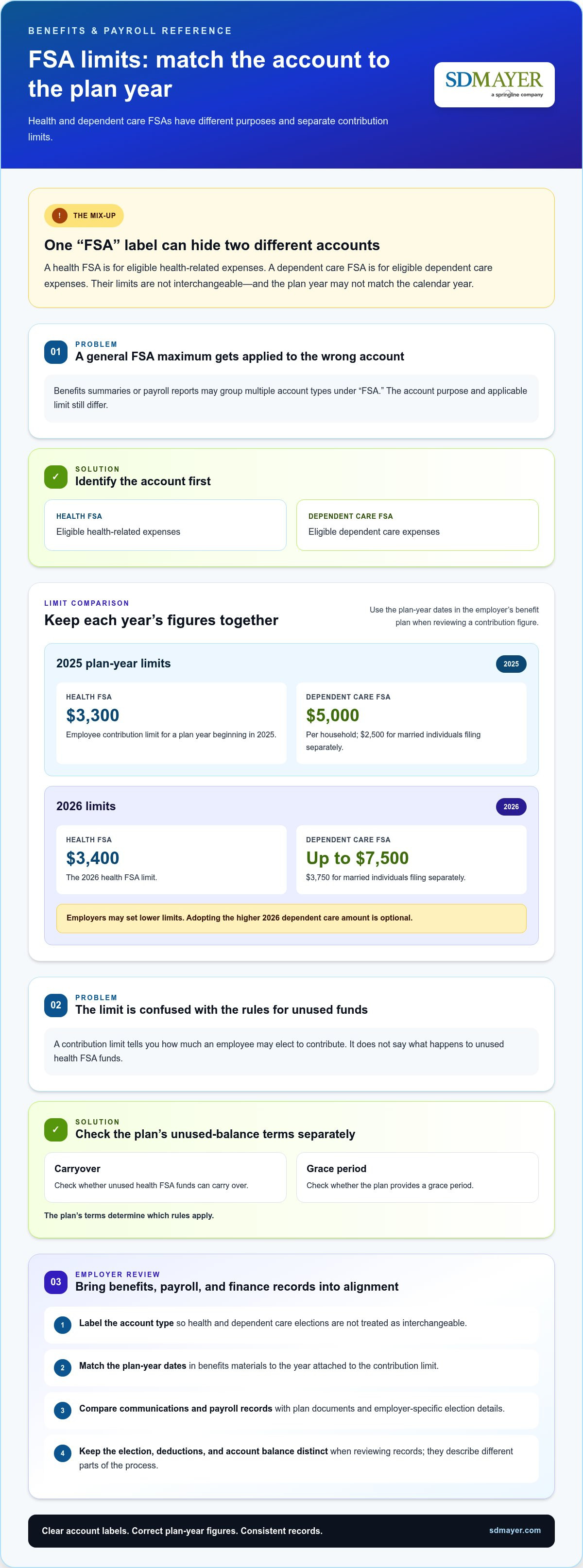
The right FSA number can still be wrong if it belongs to the wrong account or plan year. For 2025, the health FSA limit was $3,300, while the dependent care FSA limit was $5,000 per household, or $2,500 for married individuals filing separately. Those 2025 FSA limits are easy to mix up when payroll records and benefits materials cover more than one account type.
The figures also changed for 2026: the health FSA limit is $3,400, and the dependent care FSA limit can be as high as $7,500, or $3,750 for married individuals filing separately. Employers may set lower limits, and adopting the higher 2026 dependent care amount is optional. Your plan’s terms also determine whether unused health FSA funds can carry over or whether a grace period applies.
This guide explains which limit applies to each account, how plan elections and deadlines fit in, and what employers should review in benefits communications and payroll records. For mid-sized companies, matching plan-year figures across benefits, payroll, and finance records helps employees and internal teams work from the same information. In Northern California and the Greater San Francisco Bay Area, that coordination can be part of a wider effort to keep growing finance operations organized.
Key Takeaways
- The 2025 fsa limits depend on whether the account is for health expenses or dependent care. Identify the account type before reviewing elections.
- Contribution limits and rules for unused balances are separate. Check plan terms for carryover or a grace period.
- Review benefits communications and payroll records together to confirm they use the right plan-year figures and distinguish the two account types.
- Accurate benefits data supports clear bookkeeping and financial reporting for mid-sized businesses.
What Were the 2025 FSA Limits? Start With the Right Account
A flexible spending account (FSA) is an employer-sponsored account that lets employees set aside money for eligible expenses. The term can refer to different accounts, and their contribution limits aren’t interchangeable. To find the right figure, identify whether you’re looking at a health FSA or a dependent care FSA, then check the plan year that applies.
For health FSA plan years beginning in 2025, the most an employee could contribute through payroll was $3,300. The IRS announced this limit in Revenue Procedure 2024-40. It applies to health FSA contributions, not every type of FSA. That distinction matters when a benefits summary or payroll report groups multiple accounts under the general FSA label.
Health FSA limit for the 2025 plan year
The $3,300 limit applies to employee contributions to a health FSA for a plan year beginning in 2025. The plan year is the period set out in the employer’s benefit plan, and it may not match the calendar year. Before applying the limit, compare the plan-year dates in the benefits materials with the year attached to the contribution figure.
For a mid-sized employer, checking those dates helps finance and payroll teams match employee elections to the correct period. If an enrollment guide covers a plan year that crosses calendar years, use the same plan-year dates and account category when reviewing payroll records. The general overview of a Flexible Spending Account (FSA) also distinguishes account types, but the employer’s plan materials are the practical reference for an employee’s specific election.
Dependent care FSA limit for 2025
The dependent care FSA limit for 2025 was $5,000 per household, or $2,500 for a married person filing separately. This account is intended for eligible dependent care expenses, not health care expenses. The shared “FSA” label can make the accounts look similar in a benefits system, but their purposes and limits differ.
Employers may set plan terms and election procedures that affect participation. Before using a figure in a payroll file or employee notice, compare it with the plan documents and identify the account type, applicable plan-year dates, and employer-specific election details. Keep the key 2025 fsa limits distinct: $3,300 for a health FSA plan year beginning in 2025, and $5,000 per household for a dependent care FSA, with a separate amount for married individuals filing separately.
Starting with the account type and plan year gives employees and finance teams a clear reference point. Then check how each account’s rules apply to the elections and records your team is reviewing.
Health FSA and Dependent Care FSA: What the Limits Cover
The key difference is the type of expense each account is designed to help cover. A health FSA is for eligible health-related expenses under the plan. A dependent care FSA is for eligible dependent care expenses under its plan rules. The 2025 fsa limits apply separately, so a payroll or benefits system that groups both under “FSA” should still show which account an employee elected.
| Account | Purpose | 2025 limit | Plan considerations |
|---|---|---|---|
| Health FSA | Eligible health-related expenses | $3,300 for a plan year beginning in 2025 | Check the plan year, eligible expenses, and how elections and reimbursements are recorded. |
| Dependent care FSA | Eligible dependent care expenses | $5,000 per household, or $2,500 for married individuals filing separately | Check filing status, participation terms, and the plan’s election process. |
What a health FSA limit applies to
The health FSA limit is the maximum employee salary-reduction contribution for the applicable plan year. It isn’t a general FSA cap, and it doesn’t describe every detail of how an employee accesses reimbursements. Keep the annual election separate from payroll deductions already taken and from any balance shown in an account record. These figures describe different parts of the process.
Eligible expenses are governed by the applicable plan rules. The IRS’s IRS Publication 969 provides guidance on health FSAs and tax-favored health plans. For day-to-day administration, employees and finance teams should also use the plan’s materials to understand covered expenses and how to submit claims.
How dependent care FSA rules differ
A dependent care FSA has a separate purpose and limit. Its funds relate to eligible dependent care expenses under the plan’s framework, not health care expenses. For 2025, the limit was $5,000 per household; for a married individual filing separately, it was $2,500. This filing-status distinction is one reason to avoid using a single generic “FSA maximum” in enrollment instructions or payroll references.
For mid-sized employers, make the distinction visible in both benefit communications and internal records. Label each account by type, match the election to the correct plan year, and record the applicable limit alongside the account name. Then use the plan documents to confirm participation and election details, including how eligible expenses are defined. This gives employees a clearer reference and helps payroll and finance teams reconcile the right elections without treating the accounts as interchangeable.
If your team is aligning benefits figures with payroll and accounting records, discuss your finance and payroll processes with SD Mayer. The firm provides payroll and Client Accounting & Advisory Services (CAAS) to support connected accounting operations.
Carryover, Grace Period, and Plan-Year Rules: Avoid Common FSA Confusion
The annual contribution limit answers how much an employee may elect to contribute. It doesn’t tell you what happens to unused funds at the end of the plan year. That’s a separate plan feature, and it can affect how employees plan eligible expenses and interpret account balances.
An FSA’s treatment of unused funds depends on the employer’s plan terms. A plan may offer a carryover or a grace period, but employees shouldn’t assume either feature is available. For a health FSA plan year beginning in 2025, a plan that permits carryover may allow up to $660 to move into the next plan year. The plan can set a lower amount or not offer carryover.
Carryover is not the same as a contribution limit
A carryover is a plan feature that lets an employee move eligible unused health FSA funds into the following plan year, subject to the plan’s terms and limit. It is not an additional annual election and does not increase the amount the employee could contribute during the original plan year. For a 2025 plan year, the maximum permitted carryover into 2026 is $660, if the plan offers this feature.
This distinction matters in payroll and benefits records. For example, a balance carried forward should not be mistaken for a new salary-reduction election. Keep the employee’s election and any permitted carryover identifiable as separate figures, and use the plan documents to confirm how the carryover works.
Check grace-period and plan-year language
A grace period is a plan-defined extension of up to 2.5 months after the plan year to incur eligible expenses using remaining funds. It differs from a carryover: one extends the time to incur expenses, while the other can move eligible funds into the next plan year. A health FSA plan may offer one option or neither, but it cannot offer both.
Use this comparison when reviewing benefits materials:
| Feature | What it does | What to check |
|---|---|---|
| Carryover | Moves eligible unused funds into the next plan year, if offered | Whether the plan allows it and the applicable amount |
| Grace period | Allows additional time to incur eligible expenses, if offered | Whether the plan provides it and the dates that apply |
Start with the plan-year dates in the benefits materials, then locate the section describing unused balances and deadlines. For mid-sized employers, finance, benefits, and payroll teams can use the same plan language when reviewing employee communications and account records. This helps prevent a calendar-year date or contribution limit from being mistaken for the deadline or rule governing unused funds.
Keep the 2025 FSA limits and unused-balance terms in separate fields in internal reference materials. Confirm the applicable plan’s wording before communicating deadlines or expected balances, especially if the plan year doesn’t follow the calendar year.
A Mid-Sized Employer's 2025 FSA Review: Five Practical Steps
For a mid-sized company, checking FSA figures is a coordination task as much as a number check. Benefits materials, plan documents, payroll elections, and finance records should point to the same account type and plan year. Use this five-step review to make the process clear and leave a record your team can refer back to.
- Start with the governing plan materials. Locate the plan year and terms for each account. Confirm which figures apply to the health FSA and which apply to the dependent care FSA. Use the plan documents as your reference when a general benefits summary is less specific.
- Separate account types in employee communications. Review enrollment guides, notices, and internal FAQs for clear labels. Show health FSA and dependent care FSA elections separately, with each account’s applicable 2025 limit. Use plain language to identify plan-specific details, such as election procedures and how unused funds are treated.
- Compare elections with payroll setup. Check that payroll records reflect approved election amounts, account type, plan-year dates, and effective dates. Compare a sample of employee records against the source materials, then resolve differences before relying on reports or sharing totals. Keep health and dependent care deductions distinct in the system and review files.
- Assign owners and review together. Name a benefits owner to interpret plan materials, a payroll owner to check deductions and dates, and a finance reviewer to compare the results with internal records. For a mid-sized employer with several teams or locations, a shared review helps prevent different versions of the figures from circulating across departments.
- Document the check. Record the source document, applicable plan year, reviewer, review date, and date employee communications were issued. Keep notes on corrections and approvals with the related payroll or bookkeeping records. This creates a practical reference when the team reviews elections, reporting, or the next enrollment cycle.
Use a consistent recordkeeping approach: retain the plan materials that support the figures, the payroll setup reviewed, and the final employee-facing communication. Tie the 2025 FSA limits to a source and plan year rather than copying them into a later period without review. Broader bookkeeping practices can help teams keep benefit-related records organized alongside other finance activity.
Integrated accounting support can connect payroll, bookkeeping, and financial reporting processes. SD Mayer provides outsourced CFO and controller support, bookkeeping, payroll, and financial reporting through its CAAS services. Talk with SD Mayer about coordinating payroll and accounting records as part of your finance processes.
How SD Mayer Supports Mid-Market Finance and Payroll Readiness
FSA figures sit within a larger set of finance records. Payroll elections affect payroll data, while bookkeeping and financial reporting help a business organize and review its financial activity. Keeping those records aligned with benefits information helps mid-market teams work from consistent figures when they prepare internal reports or review payroll entries.
Connect payroll details with the broader finance picture
For 2025 FSA limits, the practical focus is consistency: use the plan year and account labels from the benefits materials when reviewing payroll records. A health FSA election and a dependent care FSA election should remain distinguishable in internal reporting. That makes it easier for finance and payroll teams to trace figures to the right source without confusing an employee election with a broader expense or reporting category.
SD Mayer provides payroll and Client Accounting & Advisory Services (CAAS), bringing accounting and advisory support together. For a mid-sized company, this support can connect payroll information with bookkeeping and financial reporting processes. Plan documents establish the plan-specific terms, while clear company records help teams apply that information consistently.
As reporting needs grow, leaders may also need a wider view of cash flow, budgets, and business decisions. Discuss your broader finance and advisory needs with SD Mayer as part of that planning.
Choose coordinated support as the business grows
A growing company may have finance responsibilities spread across payroll, bookkeeping, tax, reporting, and operational planning. Coordinating these areas helps teams maintain a clearer picture of how information moves through the business. SD Mayer integrates tax, audit, advisory, and accounting capabilities to support mid-market businesses as their finance needs evolve.
That support connects surrounding finance processes: maintaining useful records, linking payroll activity with accounting information, and preparing reporting that helps leaders understand the business. For companies in Northern California and the Greater San Francisco Bay Area, coordinated support can help mid-market teams manage changing finance needs while keeping information organized across locations or states.
To put the ideas in this guide to work, identify who owns payroll, bookkeeping, and financial reporting, then map how benefits-related figures flow between those records. Bring together the relevant plan materials and internal reporting needs so the right teams can review them in context. SD Mayer’s integrated accounting and advisory services support businesses as their finance priorities grow and change.
Build a Clearer Finance Rhythm for the Year Ahead
Use the next benefits review as a chance to strengthen how teams share financial information. Rather than treating the 2025 fsa limits as a one-time lookup, build a repeatable handoff between benefits, payroll, and finance when plan communications or elections change. Assign an owner to keep the shared reference current, and set a review point that fits your company’s planning cycle. That process can help teams stay aligned as responsibilities shift or the business grows.
For mid-market companies, this coordination belongs within a broader finance picture. Payroll data, bookkeeping, tax considerations, and financial reporting all contribute to informed decisions. Support that connects these areas can help leaders see how routine processes fit together while keeping employee-related details clear. SD Mayer is rooted in the San Francisco Bay Area and works with mid-market businesses on accounting and advisory needs.
As you plan your next finance priorities, connect with SD Mayer about your mid-market accounting and payroll needs. The firm’s CAAS team can bring outsourced CFO and controller support, bookkeeping, payroll, and financial reporting together around your business’s needs.
Frequently Asked Questions
What was the 2025 health FSA contribution limit?
For a health FSA plan year beginning in 2025, the maximum an employee could contribute through payroll was $3,300. When reviewing 2025 fsa limits for payroll, compare the plan-year dates with the dates attached to the election. A benefits year may not match the calendar year, so the calendar date of a deduction alone may not identify which limit applies.
What was the 2025 dependent care FSA limit?
The 2025 dependent care FSA limit was $5,000 per household, or $2,500 for a married individual filing separately. The filing-status amount matters when reviewing an employee’s election, but the account’s plan terms still guide participation and eligible expenses. Keep dependent care elections in a separate record from health FSA elections so a limit from one account isn’t applied to the other.
Was the 2025 FSA limit different from the 2026 limit?
Yes. The health FSA limit rose from $3,300 for plan years beginning in 2025 to $3,400 for plan years beginning in 2026. The dependent care FSA limit was $5,000 per household in 2025, while the 2026 limit can be $7,500, or $3,750 for married individuals filing separately. Employer adoption of the higher 2026 dependent care amount is optional, so review the current plan materials.
Can an employer set an FSA contribution limit below the IRS maximum?
Yes. The IRS maximum is a ceiling, not a required election amount for every employer’s plan. An employer may set a lower limit, so employees shouldn’t assume the federal maximum is the amount available through their workplace. Review the enrollment guide or plan documents for the employer’s actual election limit, then compare that figure with payroll setup before submitting or updating an election.
Can unused 2025 FSA money carry over into the next plan year?
It may, if the health FSA plan includes a carryover feature. For a 2025 plan year, the maximum health FSA carryover into the next plan year is $660, but the employer’s plan may allow less or no carryover. Don’t treat this as an automatic extension or assume it applies to a dependent care FSA. Review the plan’s unused-funds terms and relevant dates.
Is a grace period the same as an FSA carryover?
No. A carryover can move eligible unused health FSA funds into the next plan year, while a grace period gives additional time to incur eligible expenses using remaining funds. A health FSA plan may offer one option or neither, but it can’t offer both. Check the plan document for the feature provided, the dates involved, and how the plan applies it to remaining funds.
Does a dependent care FSA count toward the health FSA limit?
No. A dependent care FSA has its own contribution limit and is separate from a health FSA, so its election doesn’t use up the health FSA limit. Employees may have both accounts if their employer’s plan permits participation, but each election should be reviewed on its own terms. For a clear record, label account type, plan year, and election amount separately in benefits and payroll materials.
SECURITIES AND ADVISORY DISCLOSURE:
Securities offered through Valmark Securities, Inc. Member FINRA, SIPC. Fee based planning offered through SDM Advisors, LLC. Third party money management offered through Valmark Advisers, Inc a SEC registered investment advisor. 130 Springside Drive, Suite 300, Akron, Ohio 44333-2431. 1-800-765-5201. SDM Advisors, LLC is a separate entity from Valmark Securities Inc. and Valmark Advisers, Inc. Form CRS Link
DISCLAIMER:
This material has been prepared for informational purposes only, and is not intended to provide, and should not be relied on for, accounting, legal or tax advice. The services of an appropriate professional should be sought regarding your individual situation.
HYPOTHETICAL DISCLOSURE:
The examples given are hypothetical and for illustrative purposes only.