
Did you know that high-earning tech professionals in San Francisco now face a combined marginal tax rate exceeding 52% on their equity compensation? When you factor in California's uncapped payroll taxes and the new 2026 AMT phaseout rules, stock option tax planning Bay Area professionals rely on has become more than just a convenience; it's a vital strategy for protecting your wealth. It's frustrating to spend years building a company only to watch more than half of your potential gains disappear because of a simple timing error or a lack of specialized insight from a generalist CPA.
We understand the anxiety that comes with managing complex ISOs, NSOs, and RSUs. You deserve a partner who recognizes that your financial life doesn't happen in a silo. We're going to show you exactly how to evaluate a tax advisor who can protect your equity from the "AMT surprise" and ensure you never miss a critical 83(b) election window again. This guide provides a clear roadmap for exercising your options, minimizing your 2026 liabilities, and finding a holistic mentor who integrates expert tax strategy with your broader wealth management goals.
Key Takeaways
- Discover why California’s unique tax landscape makes national advice risky and why you need a strategy tailored to the Bay Area's high-stakes liquidity events.
- Learn how to evaluate a specialist for stock option tax planning Bay Area by identifying the key differences between a standard CPA and an equity compensation expert.
- Master the "Equity Alphabet" of ISOs, NSOs, and RSUs to avoid costly mistakes like missing the 30-day 83(b) window or triggering unexpected AMT liabilities.
- Build a strategic 12-month countdown for an upcoming IPO or secondary market sale to ensure you keep more of your hard-earned wealth.
- Understand the value of an integrated "Full Circle" approach where your tax and wealth management teams work together to create a seamless roadmap for your financial future.
Why Stock Option Tax Planning is Different in the Bay Area
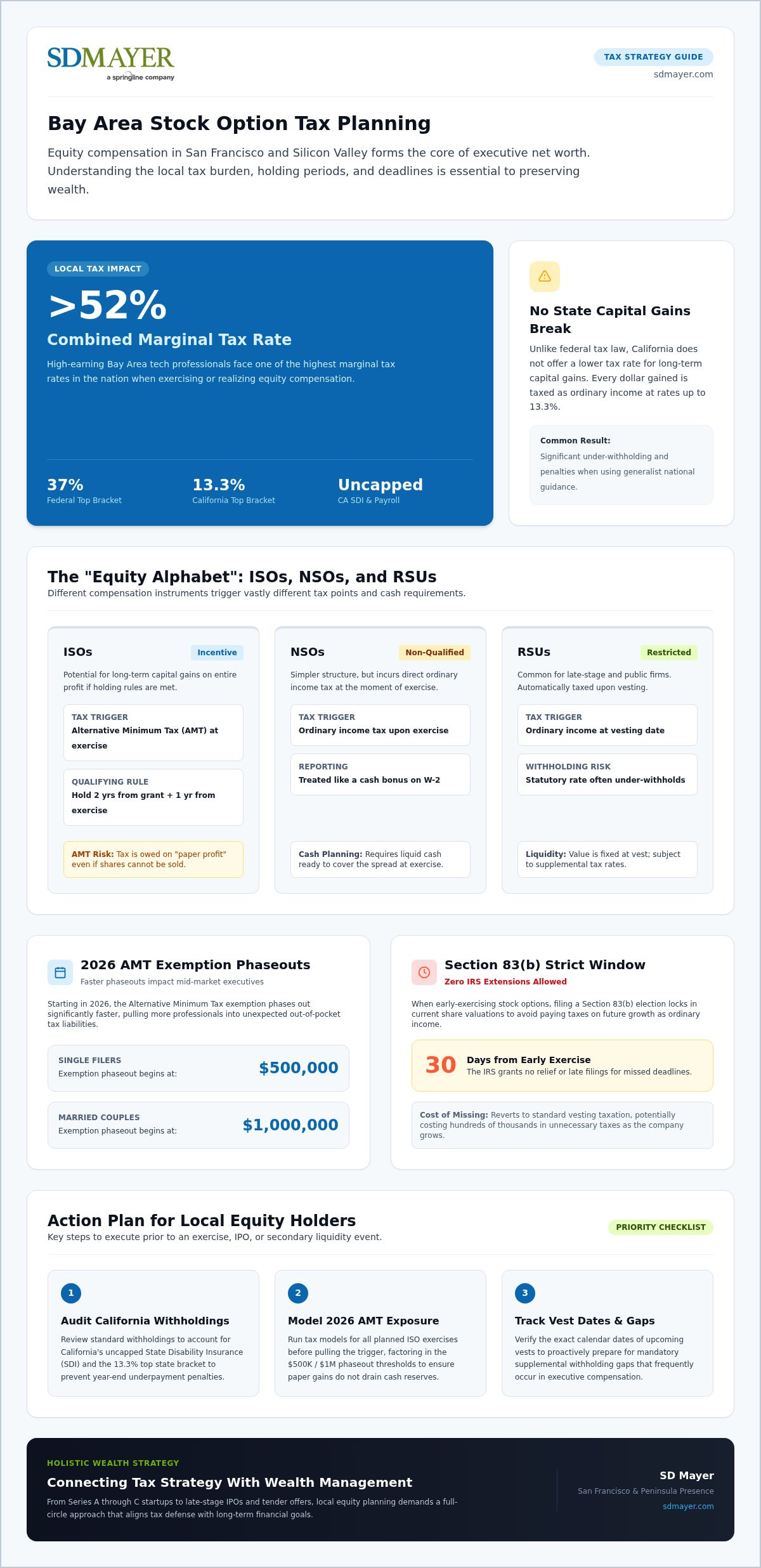
In most parts of the country, a stock option grant is a nice bonus. In San Francisco and Silicon Valley, it's often the cornerstone of your entire net worth. Because the stakes are so high, generic financial advice can be dangerous. High-earning founders and executives in the region currently face a combined marginal tax rate exceeding 52%. This includes the 37% federal rate, California’s 13.3% top bracket, and the uncapped State Disability Insurance tax. If your advisor doesn't live and breathe the local tax code, you're likely leaving a significant portion of your equity on the table.
Effective stock option tax planning Bay Area professionals need isn't just about filling out forms in April. It's a year-round defensive strategy. Unlike the federal government, California doesn't offer a lower tax rate for long-term capital gains. Every dollar you gain from a stock sale is taxed as ordinary income at rates up to 13.3%. National firms often overlook this nuance, leading to massive under-withholding and painful penalties. Strategic planning means looking at the big picture, from your initial grant to the final liquidity event, to ensure you aren't hit with a tax bill you can't afford to pay.
The Cost of Waiting Until Tax Season
Waiting until April to think about your equity is a recipe for disaster. By the time you start your return, the most impactful deadlines have already passed. For instance, if you early-exercise stock but miss the 30-day window to file a Section 83(b) election, the IRS offers no extensions. You're stuck with the standard tax treatment, which could cost you hundreds of thousands of dollars in the long run.
We also see many tech professionals fall into the "AMT surprise." When you exercise incentive stock options (ISOs), you might trigger the Alternative Minimum Tax on the "paper profit" of shares you haven't even sold yet. In 2026, the AMT exemption phases out much faster, starting at just $500,000 for single filers. Without proactive planning, you could end up owing a massive cash payment to the IRS while your wealth is still locked in illiquid shares.
Bay Area Expertise: Why Local Roots Matter
The lifecycle of a Series A through C startup in Menlo Park or San Jose moves at a different speed than a traditional mid-market business. We've spent decades in the Russ Building and across the Peninsula, building relationships with the VCs and founders who drive this economy. This local perspective allows us to anticipate how a secondary market sale or a structured tender offer will impact your specific tax bracket.
At SD Mayer, we operate with a "First Call" mentality. We want to be the partner you reach out to before you sign a new offer letter or exercise a single share. Our integrated approach ensures that your tax strategy, wealth management, and long-term financial goals are all pulling in the same direction. In a market this volatile, having a steady, local guide makes all the difference.
- Review your current withholding to account for California's uncapped SDI and 13.3% top rate.
- Model your 2026 AMT exposure before exercising any ISOs this year.
- Verify the exact date of your next vest to ensure you're prepared for the mandatory supplemental withholding gap.
The 'Equity Alphabet': ISOs, NSOs, and RSUs Simply Explained
Equity compensation is rarely a one size fits all arrangement. Most tech professionals in the San Francisco region receive a mix of different instruments, each with its own set of rules and tax consequences. Understanding the "Equity Alphabet" is the first step in effective stock option tax planning Bay Area experts recommend. If you don't know whether you're holding ISOs, NSOs, or RSUs, you can't accurately predict your cash flow or your tax bill.
Incentive Stock Options (ISOs) and the AMT
ISOs are often considered the gold standard because they offer the potential for significant tax savings. If you follow the holding period rules, you only pay the lower long-term capital gains rate on the entire profit. However, these options come with a hidden trap called the Alternative Minimum Tax (AMT). When you exercise ISOs, the "paper profit" is counted as income for AMT purposes, even if you haven't sold the shares yet.
The 2026 tax year brings new challenges for ISO holders. The AMT exemption now begins to phase out at $500,000 for single filers and $1 million for married couples. This means more mid-market executives will face an immediate cash tax bill upon exercise. The California FTB equity compensation guidelines provide a technical look at how these events are sourced, but the practical reality is that you need a strategy to exercise without draining your bank account. Qualifying for the best rates requires holding your shares for at least two years from the grant date and one year from the exercise date.
RSUs and NSOs: Managing the Cash Outflow
Restricted Stock Units (RSUs) and Non-qualified Stock Options (NSOs) are simpler but often more expensive. RSUs are taxed as ordinary income the moment they vest. NSOs are taxed when you exercise them. In both cases, the value is treated just like a cash bonus on your W-2. The biggest issue for high earners is the "withholding gap." Employers typically withhold about 32.23% for federal and state taxes combined. But if your actual top rate is over 52%, you're left with a 20% shortfall that you'll have to pay out of pocket later.
Managing this gap requires a proactive "sell-to-cover" strategy or setting aside cash from every vest. If you're feeling overwhelmed by these acronyms, reaching out for a quick conversation can help clear the air and ensure you aren't blindsided by a massive tax bill in April.
Before your next planning session, gather the following details for every grant you hold:
- Grant Type: Is it an ISO, NSO, or RSU?
- Vesting Schedule: When do the next shares become yours?
- Exercise Price: What is the cost to buy your options?
- Current Fair Market Value: What are the shares worth today?
- Holding Period: How long have you owned your exercised shares?
How to Choose a Stock Option Tax Partner: A Buyer's Framework
Selecting a partner for your financial journey is a significant decision that shouldn't be taken lightly. Many tech professionals start with a generalist CPA, which works well for standard W-2 income. However, when your net worth is tied to high-growth equity, that gap in specialized knowledge becomes a liability. You need an advisor who understands the IRS stock option guidelines inside and out, particularly how those federal rules collide with California's aggressive tax sourcing. A specialist doesn't just record history; they help you write it by anticipating your needs before a liquidity event occurs.
The ideal firm offers what we call "Full Circle" services. This means your tax strategy, wealth management, and business advisory all happen under one roof. If your tax preparer isn't talking to your wealth manager, you risk making decisions that look good on a spreadsheet but fail to protect your long-term wealth. This integrated approach is vital for stock option tax planning Bay Area leaders require as they scale from Series B startups toward an IPO. You need a team that uses modern, cloud-based planning tools to model scenarios in real time, ensuring you're never surprised by a bill you didn't see coming.
4 Questions to Ask Your Potential Tax Advisor
Before you commit to a partnership, vet your advisor with these specific questions to ensure they have the depth of experience you need:
- How many clients have you guided through an IPO or M&A deal in the last two years?
- Do you handle both the personal tax return and the broader wealth management strategy together?
- What specific process do you use for modeling different exercise scenarios to predict my cash flow needs?
- How do you stay updated on California-specific SALT changes and residency audit trends for 2026?
The Value of the BDO Alliance for Bay Area Clients
SD Mayer is a member of the BDO Alliance USA, which gives our clients a unique advantage. You receive the personal attention and local roots of a San Francisco boutique firm, but you also have access to the resources of a global powerhouse. This is a crucial benefit if your company expands internationally or if you decide to relocate. For those navigating the legal complexities of visas and residency during such transitions, you can learn more about MJ Law, an immigration firm based in San Jose. We maintain our "First Call" mentality while leveraging a massive network of specialists.
This partnership provides access to experts in niche areas like R&D credits or international tax compliance when your situation becomes more complex. Whether you are working in the Russ Building or from a home office in Menlo Park, you get the sophisticated support you deserve without the cold detachment of a massive institutional firm. We act as your holistic mentor, ensuring your equity strategy is both stable and forward-thinking.
Action Items for Choosing a Partner:- Request a sample scenario plan to see how a firm models AMT and withholding gaps.
- Confirm the firm has experience with your specific company stage (e.g., Series C or Pre-IPO).
- Ask how they coordinate between tax planning and investment management to avoid siloed errors.
Strategic Timing: Planning for Liquidity Events and IPOs
In the San Francisco tech ecosystem, timing isn't just about watching the stock price. It's about watching the tax calendar. Whether your company is preparing for an IPO or organizing a secondary market tender offer, the decisions you make twelve months before the event will determine how much of your wealth you actually keep. Growth stage companies with $10 million to $50 million in annual revenue are increasingly providing early liquidity, but these opportunities come with complex tax withholding requirements that catch many off guard. Effective stock option tax planning Bay Area professionals use involves looking past the initial excitement to model the actual cash that hits your bank account after the 52% combined top marginal rate takes its cut.
Secondary market sales are particularly tricky because they often happen while the company is still private. You might be selling "paper wealth" for real cash, but without the right strategy, you could face a significant withholding shortfall. Because federal supplemental withholding is capped at 22% for amounts under $1 million, but your actual federal rate could be 37%, you may find yourself with a 15% to 20% cash gap that must be covered via quarterly estimated payments to avoid IRS penalties.
The Pre-IPO Checklist
If your company is on a 12-month countdown to an IPO, your planning needs to shift into high gear. This is the time to model your "Net Proceeds," which accounts for federal and California taxes, Medicare, and the uncapped State Disability Insurance tax. You should also coordinate with your wealth manager to establish a 10b5-1 trading plan. These plans are essential for insiders to sell shares legally without running into insider trading concerns. By setting your sell targets early, you create a disciplined path to diversification once the lockup period ends, protecting you from the volatility that often follows a public debut.
Qualified Small Business Stock (QSBS) Optimization
Section 1202, or Qualified Small Business Stock (QSBS), is perhaps the most powerful tool for Bay Area founders and early employees. If your startup qualifies, you could potentially exclude up to $10 million in capital gains from federal taxes. However, there is a major "California trap" to consider. While the federal government offers this 100% exclusion, California strictly does not conform to Section 1202. This means you will still owe the full 13.3% state tax on those gains. Documenting your holding period and ensuring your company meets the "active business" requirements is vital to securing the federal break. If you're unsure if your shares qualify, contact our team for a QSBS eligibility review before you commit to a sale.
- Review your grant dates today to see if you've hit the five year mark required for QSBS federal tax exclusion.
- Calculate your withholding gap on any planned secondary sales to avoid underpayment penalties.
- Schedule a meeting with an integrated tax and wealth advisor at least six months before a projected IPO.
The SD Mayer Difference: Integrated Tax and Wealth Strategy
Most accounting firms operate like historians; they look at what you've already done and record it on a tax return. At SD Mayer, we built our firm on the principle that "Advice Meets Action." We believe that the most effective stock option tax planning Bay Area professionals can receive happens when your CPA and your wealth manager are in the same room. By integrating these two disciplines, we eliminate the communication gaps that lead to missed opportunities or costly tax errors. Our San Francisco roots and membership in the BDO Alliance give us the unique ability to provide boutique, personal service backed by global resources.
We take pride in our "First Call" mentality. This means we're a proactive partner in your financial life. We don't wait for you to realize there is a problem; we reach out to you before critical deadlines hit. Whether it's a reminder about an upcoming vest or a strategy session before a secondary market sale, we're looking at the big picture. Our founder, Stephen D. Mayer, has over 40 years of experience guiding clients through the volatile cycles of the Bay Area economy. We've evolved beyond simple number-crunching to become a steady companion through every stage of your career, from your first Series A grant to your eventual retirement.
Beyond the Tax Return: Wealth Management for Tech Leaders
Managing a concentrated stock position requires more than just knowing the tax code. It requires a forward-thinking strategy that balances your risk with your long-term goals. We help you integrate estate planning into your equity strategy, ensuring that your wealth is protected for the next generation. For high-net-worth families, our family office services provide a comprehensive way to manage trust accounting, financial reporting, and complex business structures. We understand that your stock options are a tool for building a legacy, and we treat them with the care they deserve.
Ready to Optimize Your Equity?
If you're ready to move past the frustration of generalist advice, we're here to help. Our teams in San Francisco and Silicon Valley are agile, modern, and deeply invested in your success. When you're ready for your initial consultation, it's helpful to bring your current equity inventory, your most recent tax return, and a summary of your upcoming vesting dates. This allows us to hit the ground running and start modeling scenarios that prioritize your maximum tax savings. Don't leave your hard-earned wealth to chance. Take the first step toward a more secure financial future today.
Schedule your stock option strategy session with SD Mayer
- Gather your grant agreements and most recent W-2 to identify potential withholding gaps.
- List any major life events or liquidity goals for the next 12 to 24 months.
- Prepare a list of questions about your specific ISO, NSO, or RSU holdings for our team.
Take Control of Your Financial Future Today
Your equity represents years of hard work and innovation; don't let a lack of specialized planning erode your potential gains. We've explored how the unique 2026 California tax landscape and the complexities of ISOs, NSOs, and RSUs require a strategy that goes far beyond simple filing. By choosing an integrated partner who understands the high-stakes nature of Silicon Valley liquidity events, you can navigate these challenges with confidence.
SD Mayer brings founder-led expertise with over 40 years of experience in the local market. As a firm named one of the Top 25 Fastest-Growing Firms in 2025 by Accounting Today, we've built a "Full Circle" model that unites tax, wealth, and advisory services under one roof. This holistic approach is why we are the trusted choice for stock option tax planning Bay Area tech leaders rely on to protect their wealth.
Secure your equity's future with SD Mayer's integrated tax planning and ensure you're prepared for whatever comes next. You've built something incredible, and we're here to help you keep it.
Frequently Asked Questions
When is the best time to start stock option tax planning?
The best time to start is before you sign an offer letter or exercise a single share. Proactive stock option tax planning Bay Area professionals recommend allows you to model various exit scenarios while your strike price is still low. Waiting until a liquidity event is imminent often limits your ability to use strategies like early exercise or to start the clock for long term capital gains treatment.
What is the 83(b) election and why is it so important for Bay Area founders?
An 83(b) election is a letter you send to the IRS requesting to be taxed on the value of your equity at the time of grant rather than when it vests. For founders in San Jose or Menlo Park, this can turn potential future growth into capital gains instead of ordinary income. You must file this within exactly 30 days of your grant date, as the IRS provides no extensions.
How does the Alternative Minimum Tax (AMT) affect my ISOs in 2026?
In 2026, the AMT exemption begins to phase out at just $500,000 for single filers. This change means you might owe taxes on the "spread" between your exercise price and the fair market value, even if you don't sell the shares. Because the phaseout rate has accelerated to 50 cents per dollar, many mid market tech leaders will face a much larger cash tax bill than they did in previous years.
Can I sell my private company stock on a secondary market like Forge or Carta?
Yes, many growth stage companies now facilitate secondary sales to help employees get cash before an IPO. However, these sales trigger immediate tax liabilities. You'll need to account for the difference between the flat 22% federal withholding and your actual top tax bracket. Our team helps you calculate these gaps so you aren't surprised by a large bill during the next quarterly estimated tax payment deadline.
What is the difference between a tax preparer and a tax strategist?
A tax preparer focuses on historical reporting by putting the right numbers in the right boxes on your return. A tax strategist, like the team at SD Mayer, looks forward to help you make decisions that minimize future liabilities. We use a "First Call" mentality to ensure your equity decisions align with your wealth goals, rather than just reacting to what happened in the past year.
How does California tax stock options compared to other states?
California is unique because it does not offer a lower tax rate for capital gains. Every dollar you earn from stock options is taxed as ordinary income at rates as high as 13.3%. Additionally, the state is aggressive about sourcing income. If you earned your options while working in San Francisco but moved to a tax free state before vesting, the Franchise Tax Board will likely still claim a portion of that income.
What are the tax benefits of Qualified Small Business Stock (QSBS)?
If your startup meets specific federal requirements, Section 1202 allows you to exclude up to $10 million in gains from federal taxes. This is a massive benefit for early employees at Bay Area companies. It's vital to remember that California does not recognize this exclusion. You will still owe state taxes on the full gain, so you must plan for that cash outflow well before you sell your shares.
Do I need a separate wealth manager and CPA for my stock options?
While you can use separate firms, our "Full Circle" model proves that integrating these services reduces errors and improves results. When your CPA and wealth manager work together, they can coordinate stock exercises with your broader investment portfolio and estate plan. This seamless approach ensures that your stock option tax planning Bay Area strategy is stable, efficient, and tailored to your specific life stages and goals.
SECURITIES AND ADVISORY DISCLOSURE:
Securities offered through Valmark Securities, Inc. Member FINRA, SIPC. Fee based planning offered through SDM Advisors, LLC. Third party money management offered through Valmark Advisers, Inc a SEC registered investment advisor. 130 Springside Drive, Suite 300, Akron, Ohio 44333-2431. 1-800-765-5201. SDM Advisors, LLC is a separate entity from Valmark Securities Inc. and Valmark Advisers, Inc. Form CRS Link
DISCLAIMER:
This material has been prepared for informational purposes only, and is not intended to provide, and should not be relied on for, accounting, legal or tax advice. The services of an appropriate professional should be sought regarding your individual situation.
HYPOTHETICAL DISCLOSURE:
The examples given are hypothetical and for illustrative purposes only.